For decades, SOM designed custom furniture for workplace, cultural, and hospitality environments, reflecting an ethos of “total design” in which architecture, interiors, and furnishings comprise a unified whole. Most of these pieces, however, were never made commercially available, and SOM’s contributions to furniture design have been largely overlooked—until now. In February 2026, an exhibition of SOM-designed furniture opened in New York, showcasing more than 60 pieces of custom, archival furniture designed from 1950 to 1991, collected and curated by Rarify. And in June, the first collection of archival SOM furniture was launched, reintroducing seating from the 1970s together with tables newly designed to complement them. The release is just the first of more to come, as part of an ongoing initiative to revisit the work in the firm’s design archive and reinterpret it for today. In this interview—part of a series marking the 90th anniversary of our practice—Satya Cacioppe, head of product development at SOM, and David Rosenwasser, co-founder of Rarify, discuss their collaborative efforts to uncover a design legacy that is ripe for rediscovery.

Uncovering a Legacy of Furniture Design
With custom, archival furniture made available for the first time—and new products in the pipeline—SOM is reclaiming an often-overlooked facet of its design practice.
David, you’ve been collecting SOM-designed furniture for years. The exhibition you organized in New York in February 2026 focuses on what you’ve called SOM’s “hidden history of furniture design.” How did you become aware of and interested in this history?
David Rosenwasser: Through dealing with office liquidations, of all things. When I was still a college student and developing my business, D ROSE MOD (which preceded Rarify), I came across a liquidation from the offices of the law firm Kirkland and Ellis, an SOM project. Among the pieces of furniture being sold were a number of beautifully crafted stainless steel tables with stone and glass tops, which were mysteriously unmarked. They turned out to be works designed and constructed by Nicos Zographos, an architect and industrial designer who worked at SOM for a number of years before starting Zographos Designs. My curiosity about those pieces triggered a years-long search into what I thought at first was just the work of Zographos. It turned out to instead be a vast portfolio of multifaceted, bespoke furniture designs created by numerous designers, encompassing decades of SOM pedigree.
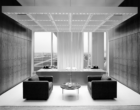
When we’ve come across these pieces in auctions and liquidations, they have been surrounded by other quite prestigious works of design. The pieces from Kirkland and Ellis, for instance, were being sold together with stainless steel Mies van der Rohe Brno chairs and Florence Knoll dining tables. And yet, the Zographos tables, from my perspective, were crafted far more painstakingly than the works from Knoll that I had seen. Even with my nascent understanding of metalcraft at that time, it was easy to understand how much time, energy, and craftsmanship went into the fabrication of these pieces.
Satya, you’ve been working from within the firm to uncover this legacy of furniture design. Tell us about your work and what you’ve found.
Satya Cacioppe: Part of my role at SOM is to commercialize the intellectual property of our designs. The thinking was that we develop custom furniture on our projects all the time—how could we get the most out of these efforts and make these pieces commercially available? When I first started, even though I had been in furniture design for many years, I wasn’t aware of SOM designing furniture or products. Even in our digitized archive, I didn’t see many examples at first. As we started asking around, a colleague in New York mentioned we had a cupboard full of sketches. What we found was a treasure trove of drawings. Thousands of drawings and furniture sketches, meticulously detailed, from decades of SOM history. It included furniture for well-known projects like the Connecticut General Headquarters, Chase Manhattan, and others that were new to me. The rigor, detail, and vast iterations were overwhelming. My eye wasn’t as developed then as it is now, and I wondered, why was SOM drawing Knoll-like tables over and over again?

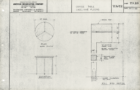
When David and I first met, he told me all about Nicos Zographos, whom he considered to be an underappreciated SOM designer. That opened up a window of possibility to understanding why we were seeing hundreds of variations emerge from seemingly familiar designs but across multiple studios, projects and manufacturers. I learned about Connecticut General, and how SOM had worked with Florence Knoll on the interiors. We knew about the work of a handful of SOM designers—Zographos, and also Davis Allen, who led the firm’s interior design department for almost 40 years, but we had to work backwards to discover Gordon Bunshaft’s furniture design work. These key figures set a program for furniture design at SOM and generated much of what we see as our furniture ethos today.
The fact that I’ve been able to come across so much of this furniture is because SOM has done so many projects of such gravity that you almost trip over them.
David: There was a lot of serendipity. The day that I came into the office for a visit, Satya and her team were preparing portfolios of furniture documents to show to another company as they were exploring how to put some of these pieces into production. That coincidence meant that I had the chance, in person, to survey these vast portfolios of work. The opportunity to help put the puzzle pieces together, and to be a champion for this work, is what any collector would dream of. It simply doesn’t get much more interesting and substantive than a giant portfolio of custom, immaculately made furniture works from the mid-20th century by SOM. And here was a chance to work with Satya, who I learned was unbelievably dedicated, as well as Karen Widi, SOM’s archivist, and others on the team. We’ve had the ability to work in this really beautiful, exploratory way, and to leverage our respective expertise.
Satya: We gave David access to all of the drawings. And I got obsessed with piecing together the lineage of designers who produced the furniture and interiors work. We kept discovering new people. Designs by Charles Pfister came out of the woodwork from his time at SOM. He designed Knoll’s best selling sofa of all time, which came out of SOM’s project for Weyerhaeuser Headquarters. Pfister designed some remarkable furniture in the 1970s which we’re bringing back into production today.
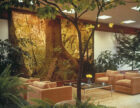
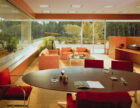
Someone once said to me, “All roads lead to SOM,” and I have found that to be surprisingly true. For instance, SOM gave the legendary textile designer Jack Lenor Larsen his first commission for a designed fabric, for Lever House, in 1951. There are so many moments like this. I don’t think anyone fully understands or can quantify the extent of SOM’s impact on interiors, or furniture, or American design. Everyone just talks about Eames and Knoll, but there are so many other designers who deserve equal recognition.
Why do you think that SOM’s furniture design has been largely overlooked until now?
Satya: I think it has to do with the fact that interior design as a profession was not given the same importance as architecture at the time. But also, I think, because SOM was an anomaly in the way it presented itself. So many of the classic pieces of modern furniture from this time bear the signature of a single, famous designer. SOM never wanted to perpetuate this idea of the architectural genius; the attitude has always been that we are a collective practice. That’s very different from the way that so much high-design furniture has been marketed and sold.
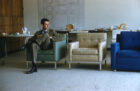
David: I think it’s also because SOM was so prolific, especially from the 1950s onward, designing so many major and influential corporate headquarters across America and the world. So, SOM could also produce some of the most notable interiors and furniture, and somehow that gets forgotten in the context of its own portfolio—even though the furniture was remarkable work, and transformative in the careers of such notable designers as Zographos, Davis Allen, Charles Pfister, David Rowland, even many of the Knoll protagonists who SOM was sort of in competition with.
Satya: Yes, like Warren Platner.
David: Ward Bennett is another. The careers of so many of these heroes would never have been possible without the opportunity to work on SOM projects. The fact that I’ve been able to come across so much on this furniture is in part because SOM has done so many projects of such gravity that you almost trip over them.
Satya: SOM is so lucky that David has taken the initiative to search for and acquire our furniture. Some of these pieces would have been lost or become harder to find. He’s collected hundreds of pieces, some of them super rare, including an original Pfister cantilever chair. I think the prices have gone up since he started collecting. Obviously, he’s bringing more awareness to it – and he’s really done the research to understand the history and document the importance of the pieces.
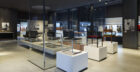
David: As a collector you have to know, on the one hand, where to look, and on the other, how to authenticate and leverage documentation. To some extent, my ability to collect pieces is only as good as the quality of the documentation that exists. Because we had the drawn portfolios with page-by-page detail, we had perfect instruction manuals for a collector. We had further documentation from the vast number of photos in Ezra Stoller’s archive. So, in a typical scenario, I would be looking through the catalog of an auction house in Connecticut, or upstate New York, and pinpoint a piece that was called “Knoll-style table,” or, maybe just “glass and chrome coffee table.” And that’s how I worked, piece by piece, with dozens of different sources, to amass these pieces from different eras. Like Satya said, we’re still learning about new work and we still have pieces on our wish list to acquire. We recently managed to track down a set of eight dining chairs that came from a project in the 1950s. That would have been in the exhibition if we had found them earlier.
Satya: Seeing all of this furniture together in one space, you see the progression of design, decade by decade.
David: Yeah, you see distinct eras. In the early years—let’s say the 1950s until the mid-1960—there’s a crisp, austere, Miesian mode of executing modernism through furniture. And then a transition: The designs maintain this modernist vocabulary, but the materials get a little jazzier. You see more bronze, the carpets become more red.
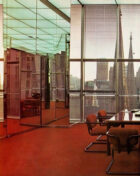
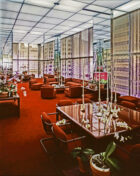
Satya: The Pfister chair, I think, is a pivotal moment, where glamour, luxury, comfort, and play come into the design vocabulary. The chair was custom-made for the office of the fashion designer Halston, and it expresses a moment where furniture and fashion design are in dialogue.
David: That’s in the late 1970s. At that time, Gordon Bunshaft and Davis Allen, who had been SOM’s pioneering designers for decades, were creating these quite radical works that were departures from their previous, crisp modernism. Suddenly, Davis Allen is doing works that reference Chinese lacquer work in a sort of postmodern design aesthetic. Bunshaft gets his last hurrah working with Allen on the interiors for the National Commercial Bank of Jeddah, amping the volume up to 11. The most recent piece in the exhibition is from 1991, a chair that Raul de Armas designed for Knoll.
Now SOM is making some of these historic designs commercially available for the first time—tell us more.
Satya: We are selectively revisiting and re-envisioning some of the most remarkable furniture from the archive. Working with our partners at Form Portfolios, we’ve been exploring how we can produce these pieces in a thoughtful way, with today’s technology. SOM has business relationships with some furniture companies that span back to the late 1930s, so it is really interesting to consider the past and future legacy of the work that we do. The first collection has just been released by IKONstudio, a new brand launched by Teknion. It includes the Pfister cantilever chair—we call it the SOM79 chair—and a new table that we’ve designed to go with it. We also have a sofa that SOM originally designed for the IBM Headquarters in Armonk, New York, in 1976. That piece is being manufactured for the first time now by Teknion, together with a family of lounge items. We have more licensed styles coming out in December with another manufacturer. The opportunity to collaborate with our furniture and manufacturing peers allows us to tap into the expertise in materials and design.They are pushing innovation and sustainability all the time, and we want to be in constant dialogue with them in order to bring the best quality of product into our projects.

A big motivation was sustainability: If we are participating in the furniture industry, how do we make sure we’re doing this in a responsible way? You have to be close to your manufacturers. As you can imagine, SOM might specify 1,000 desks for a corporate headquarters. That could be a huge amount of waste, or a huge amount of a product that’s really environmentally efficient. So we wanted to have that agency again for our projects. The lighting system we designed for Artemide is a great example of that—the design is rigorous about sustainability, reducing materials to a minimum. We want to be thinking about the environment in every aspect of how a product is made, and you can’t really do that unless you’re designing it.