Bill Baker
Story

Art and Engineering: A History of Collaboration

A new exhibition reveals the creative process behind public artworks—and shows what artists and engineers have in common.

Collaborating with artists is a through-line in SOM’s 90-year history. From early work with legendary figures such as Pablo Picasso and Alexander Calder to ongoing projects with contemporary artists, our architects and engineers have resolved the technical challenges in realizing large scale artworks—and in some cases have contributed to developing the concept for the artwork itself.

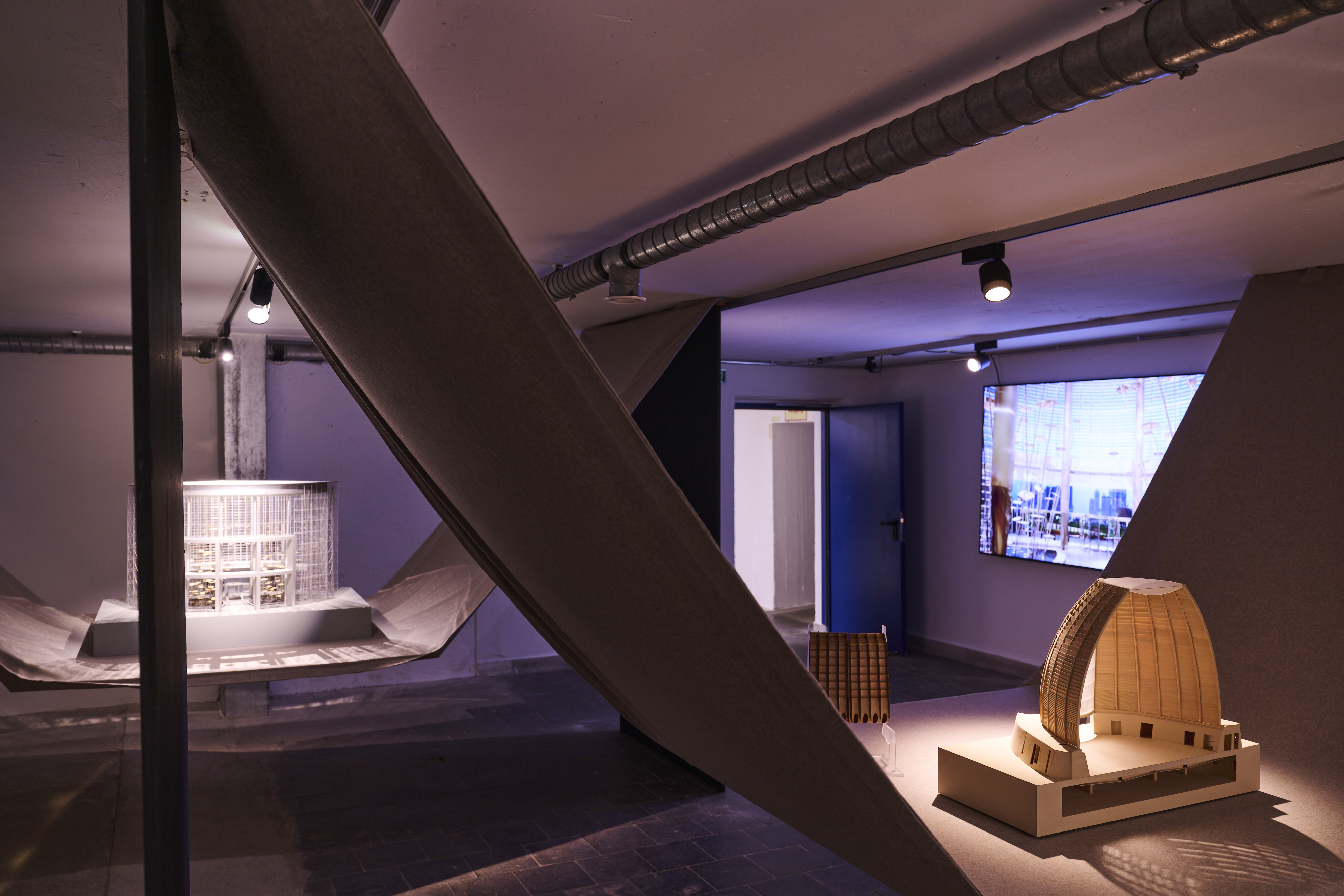
“SOM+Art,” a new exhibition at Architekturgalerie München, explores this history by presenting a rich selection of models, concept sketches, and technical drawings that reveal the process behind creating works of art. In this interview—part of a series to mark the firm’s 90th anniversary—Nicola Borgmann, director of Architekturgalerie, joins SOM’s Kent Jackson, Mark Sarkisian, and Mohamed Sheriff in a conversation on bridging the disciplines of art, architecture, and engineering.
Nicola, how did you first connect with SOM, and what convinced you there was an opportunity to do an exhibition together?

Nicola Borgmann: I first connected with SOM in 2016, when we began preparing our first exhibition together, “The Engineering of Architecture.” I was struck by their remarkable ability to explain engineering in a clear and accessible way.

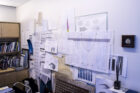
When I came to SOM’s Chicago office, I was amazed by what I saw. Visiting the lab of the so-called “Research Gang”—a group of engineers and architects formed by Bill Baker—I remember thinking that it looked like a contemporary version of a Renaissance cabinet of curiosities. There were models everywhere, full-scale details, materials, samples, prototypes. Bill immediately started showing me things, initiating me into this world of engineering magic. I understood at that moment that SOM has this incredible curiosity, a desire to experiment, to make ideas tangible, and to share them with others.

Bill Baker's office in SOM's Chicago studio
Bill Baker’s office in Chicago. © SOM

Our first show with SOM opened here at Architekturgalerie in 2016, and then traveled to Denmark, Italy, and Mexico, with new ideas added at each stage of the exhibition. It evolved to include examples of SOM’s collaborations with artists, which is a topic that I’ve always been interested in. We decided to make that the focus of this new exhibition.

That focus connects very naturally to what we do at Architekturgalerie. Since the gallery was founded in 1985, we have always worked between the professional world and the public. It can be complicated to make architecture exhibitions engaging for a general audience, and even more so when it comes to engineering. Art is a wonderful bridge in that respect. People may enter through something familiar or immediately engaging, and then find themselves looking at architecture and engineering in a completely different way.

While engineers and artists might seem to come from different worlds, they have something fundamental in common. Both are curious and experiment. Both ask, “what if?” When an artist puts forward an idea that might seem impossible, an engineer at SOM would say, “let’s find out.” That’s the creative dialogue that we show in this exhibition.

SOM’s history of artist collaborations goes back decades. How did you decide what to include in the exhibition?

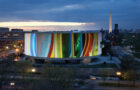
Mohamed Sheriff: We focus on key moments in SOM’s history. It starts with a museum—the Hirshhorn, designed by Gordon Bunshaft in the late 1960s. It’s a great building, but it also has become a canvas for artists, with its cylindrical facade used as a surface to project videos. Hiroshi Sugimoto also has a series of photographs of the Hirshhorn, which shows that the building itself has even been a subject of art.

Doug Aitken's video installation "SONG 1" (2012) projected on the facade of the Hirshhorn Museum
Doug Aitken's video installation "SONG 1" (2012) projected on the facade of the Hirshhorn Museum. Courtesy of the Hirshhorn Museum

Of course, we go into the firm’s historic collaborations with well-known artists such as Picasso and Miró. We have this history of collaborating with the preeminent artists of the time, and that sets the stage for the work we’ve done since. In more recent decades, SOM has engaged in long-term and ongoing collaborations with artists such as Janet Echelman, Iñigo Manglano-Ovalle, Jaume Plensa, and James Turrell. We’ve developed a substantial body of work with these artists, and I think we’ve learned a lot together.

Ultimately, this exhibition is about ideas. It shows how, through interdisciplinary collaboration, an artist’s initial idea can evolve in a previously unexpected direction. I think that’s a microcosm for how we work in general.

SOM + Art Vernissage
SOM+Art exhibition at Architekturgalerie München, 2026. © Frank Bauer
© Frank Bauer

Mark Sarkisian: Our work with Janet Echelman is a good example of this. The relationship began by chance. She was selected to contribute to the public art program for a new hotel in West Hollywood, and because SOM was the engineer for the buildings, we were brought on to collaborate with Janet to integrate her work into the site. 

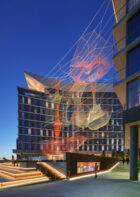
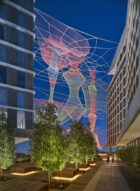
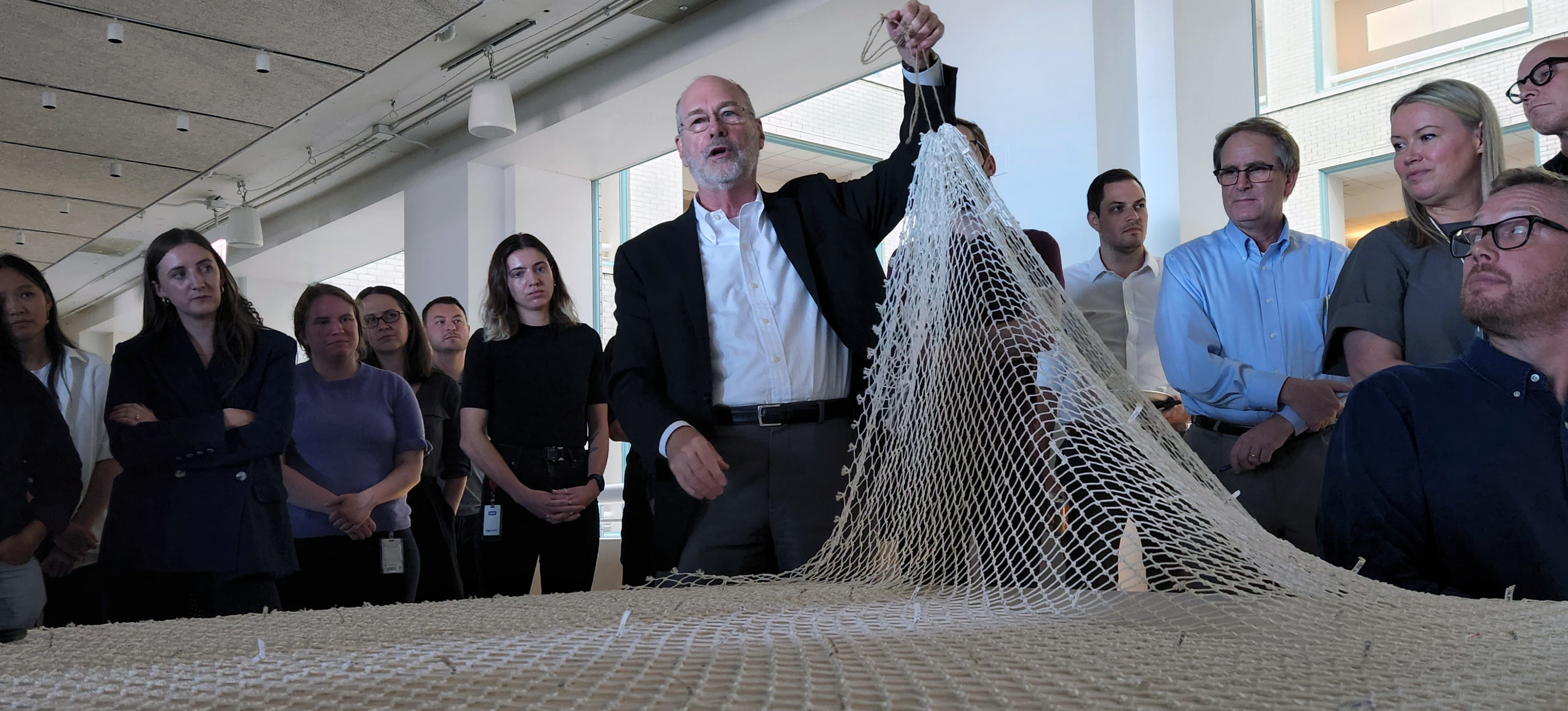
The piece that Janet envisioned was monumental in scale: a 90-foot-high fiber net sculpture that would be suspended across the space between the hotel’s two buildings. Our collaboration was very pragmatic in the beginning, but Janet was so impressed by our thinking that we ended up collaborating with her to engineer the artwork itself.

Janet Echelman "Dream Catcher" artwork
Janet Echelman’s “Dream Catcher” at 1 Hotel West Hollywood.
Dream Catcher, Janet Echelman
© Benny Chan | Fotoworks

Janet’s sculpture, titled “Dream Catcher,” is inspired by her studio’s research into visualizations of brainwave activity during sleep. It takes the form of a logarithmic spiral, which is a geometry that we had also been exploring for structural systems in tall buildings because it can result in very efficient designs.

We worked with Janet to develop both the rope and the geometric pattern that would make her net sculpture resistant to wind forces. The technology that we applied solves a very complicated engineering problem, because the net material moves in a very extreme way. Understanding how forces flow within this highly dynamic piece of art is extremely important in order to create a work that’s consistent with the artist’s vision but solves all the issues of environmental impact.

Janet has described “Dream Catcher” as opening up a new direction for her practice, in the way that the artwork is integrated with architecture and engineering. Since that project, we’ve continued to work with Janet to create many other installations around the world.

Kent Jackson: Putting together this show sparked a lot of interesting conversations about the parallel evolution of artistic and architectural practice. Art went through a huge transformation in the 1950 and 60s, just as SOM was becoming a major exponent of modernist architecture as the language for corporate and civic projects in the United States and around the world. Integrating artworks into architectural projects became an important focus, and that’s where we start to see direct collaboration between artists, engineers, and architects. For works by major figures from Picasso, to Miró, to Noguchi, we see SOM emerge as a facilitator of the artwork. 

As we looked back further in history, we started to ask, how is this different from, say,  Michelangelo’s work at the Campidoglio in Rome, where he placed the statue of Marcus Aurelius at the center of his design for a civic square? I think that with modern art and architecture, there’s a different relationship between these disciplines. Moving beyond the traditional idea of public art as sculpture on a plinth, there’s a dissolving of boundaries between art and architecture in the 20th century that becomes really interesting.

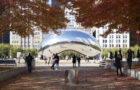
Anish Kapoor's "Cloud Gate" at Millennium Park
"Cloud Gate" in Millennium Park, Chicago. © SOM

You see this transformation emerge in SOM’s work—with Henry Moore’s work at the Banque Lambert, for instance, or the Picasso and Miró sculptures in Chicago. It goes even a step further with the artists on display in this exhibition. In the 21st century, public art starts to become more immersive. SOM’s masterplan for Millennium Park is a great example of this, where the public engages with the artwork in a more active way. You have Anish Kapoor’s “Cloud Gate,” which reflects the city back to you, distorting and transforming it. And there’s Jaume Plensa’s “Crown Fountain,” which displays the faces of Chicago residents in a series of videos that are 50 feet tall. Art and architecture are completely integrated in a truly interactive work that engages with people in the city.

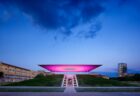
Then you look at an artist like James Turrell, who creates environments that can change your perception of the sky. These artists have an amazing ability to help us perceive things in a different way. We’re focused on helping the artist execute the idea, but we’re always thinking about how to evolve or strengthen the idea, as well.

Skyscpace
James Turrell's "Twilight Epiphany" Skyspace at Rice University. © Casey Dunn

Mohamed: You see this dynamic back-and-forth between the artist and our team in so many of these projects. I learned some fascinating things about Miró’s Chicago sculpture in doing research for this exhibition. Although Miró designed the sculpture in the 1960s, it wasn’t until the 1970s that the sculpture was finally constructed. It happened, in large part, thanks to Bruce Graham’s tireless advocacy, as well as a $60,000 donation by the SOM Foundation, which spurred other donations that allowed the sculpture to be realized.

SOM’s engineering team then got involved to determine how the sculpture that Miró envisioned could be built at a monumental scale. The team used early CAD technology to create a 3D digital model, based on Miró’s original maquette. Then, the maquette was placed in a CAT scan machine to take cross-sectional X-rays, which allowed the team to find where to place the underlying steel structure. This early use of CAD technology in the structural design for large-scale sculptures can be seen as a precursor to the work SOM did almost 20 years later, with Frank Gehry, for his fish sculpture on the Barcelona waterfront. This exhibition traces the development of these ideas and the unexpected places they lead.

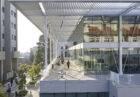
Mark: It also shows how ideas and technologies developed in collaboration with artists are applied in the buildings that we design. For instance, the exhibit highlights the Grimes Engineering Center at the University of California, Berkeley, where we studied the dynamics of structures in major earthquakes. We used a technology called shape memory alloy that will dissipate seismic energy and protect the structure in a major earthquake. It uses the same principle of dynamic behavior that you might see in Janet’s work, but it’s an engineering solution that’s part of a major building.

Grimes Center at UC Berkeley
Grimes Engineering Center at UC Berkeley. Dave Burk © SOM

Nicola: What you see across all of these projects is an interdisciplinary way of working. Nowadays, everybody talks about interdisciplinarity, but SOM has been doing this for decades, and it works in both directions. You’re building models, taking difficult concepts and making them understandable—and in doing so, you inspire completely new ideas. Your technical expertise becomes part of the creative dialogue between artists, engineers, and architects, and sometimes the result is something that neither side alone could have imagined.

This exhibition reveals the extraordinary amount of engineering that goes into making an artwork appear effortless. When we look at Picasso’s sculpture, or Janet Echelman’s delicate net structures, we ideally don’t think about how it stands up, or how forces are distributed, or how it survives a storm. But the engineering is there—and the better it is, the less we see it. Engineering can give the artist a greater freedom to work. And it can allow the idea to become larger, or lighter, or more daring, or more dynamic—sometimes even to become possible at all.

The exchange works in the other direction as well. Artists can also push the architects and engineers beyond familiar solutions. They introduce questions and aspirations that can lead to new structures, new materials, and new ways of thinking. That’s what’s really interesting—these two worlds coming together, which maybe are not so different from each other. I hope that visitors to the exhibition begin to see both disciplines differently: to see the engineering hidden within the art, and the creativity hidden within the engineering.


“SOM+Art” is on view at Architekturgalerie München through November 15, 2026.