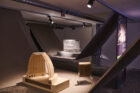
As Lever House celebrates its 75th anniversary, a new exhibition, “Isamu Noguchi at Lever House,” revisits one of the most significant unrealized collaborations in the history of American modernism. Sculptures, models, and drawings from Noguchi’s work with architect Gordon Bunshaft—including an unbuilt sculpture garden for the Park Avenue headquarters—are on view at Lever House through summer 2027. The exhibition presented the opportunity for historian Nicholas Adams to explore the collaboration between Bunshaft and Noguchi—a years-long partnership that powerfully united sculpture and architecture.
In post-war America, corporate clients took a more visible public role, with significant artistic implications. No longer linked to their manufacturing sites, they took advantage of improved communications to erect new headquarters buildings enhanced by sculpture and art works in cities across the United States and throughout the world. The architects at Skidmore, Owings & Merrill (SOM), for example, collaborated closely with many notable sculptors to make structures that contributed to urban and rural sites. In New York City, the site of just one of SOM’s offices, the array of sculptors they engaged for their buildings over the decades is extraordinary: Alexander Calder, James Carpenter, Jean Dubuffet, Jenny Holzer, James Turrell, Harry Bertoia, Henry Moore, and Alberto Giacometti. Beyond New York were many more.1 Though the work is not associated with a specific building by SOM, partners of the firm brought the monumental head by Pablo Picasso to center city Chicago (1967). In short, sculpture is an essential part of SOM’s architectural practice. This brochure will explore one of SOM’s most significant architectural-sculptural collaborations, that between their senior design partner, Gordon Bunshaft (1909-1990) and the sculptor Isamu Noguchi (1904-1988). Their collaborations took place at six sites between 1951 and 1968. Bunshaft’s buildings and Noguchi’s sculptures bring life to public spaces, deepening a visitor’s experience and, often enough, providing a welcome sense of relief or distraction. Known as iron-willed and outspoken, both men compromised sufficiently to create a remarkable collection of monumental sculpture linked to strong and powerful architecture—or, as Gordon Bunshaft might have put it, reversing the formulation: strong and powerful architecture with monumental sculpture.
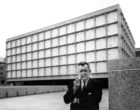
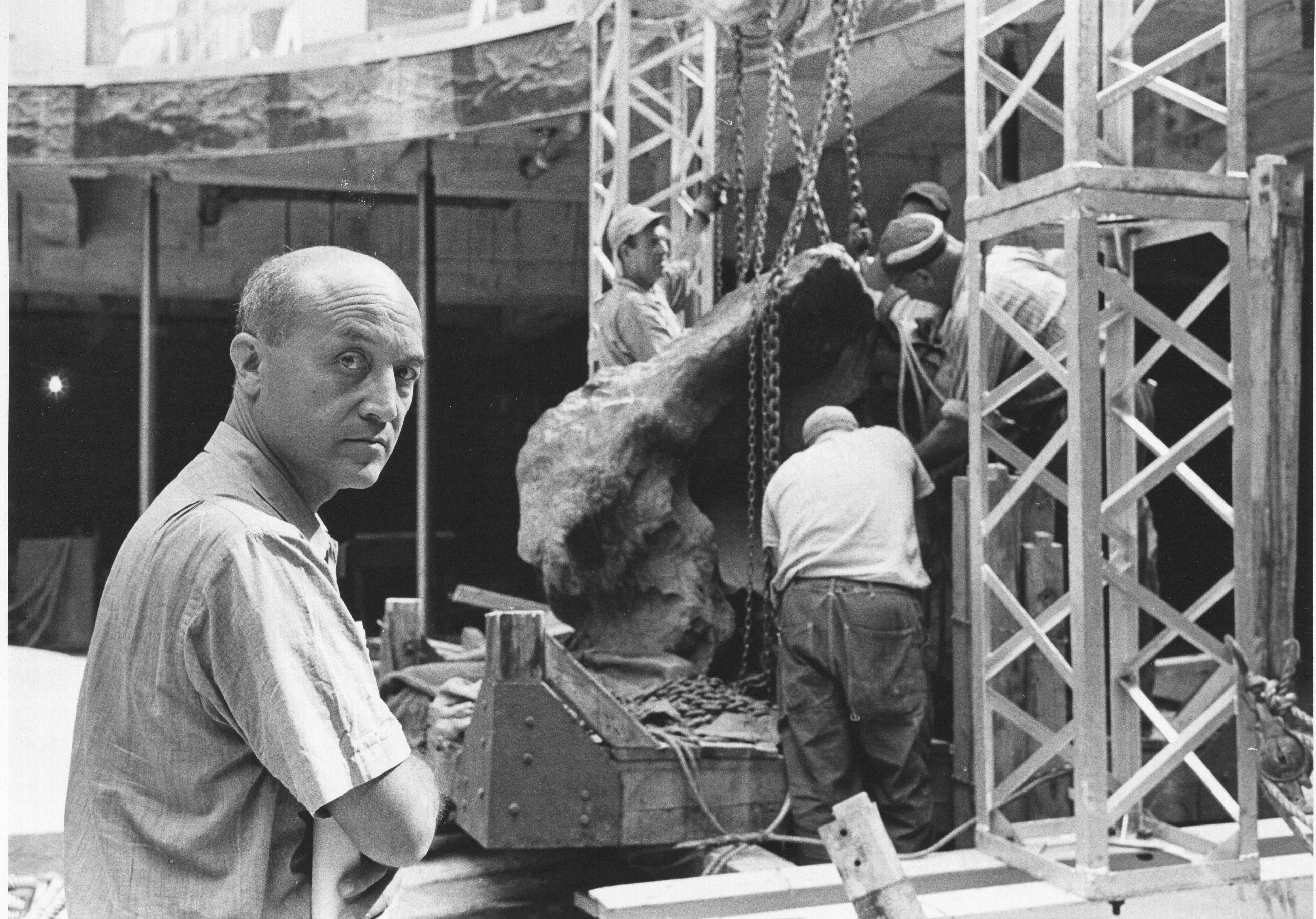
That two rather prickly, forbidding men should have worked together so effectively is perhaps a surprise. How they met is unknown. By 1937, following Bunshaft’s move to New York after graduation from the Massachusetts Institute of Technology, Noguchi’s works were being exhibited in places that the young architect would have known. Bunshaft frequented New York’s galleries and museums and might well have seen Noguchi’s sculptures on display.2 Perhaps he even met him. Bunshaft’s first employer in New York in 1937 was the architect Edward Durell Stone. Stone had designed a house in Old Westbury, New York, (1927-1938) for A. Conger Goodyear, a Buffalonian like Bunshaft. Stone collaborated with Noguchi on the design of a coffee table for the house.3 There is every reason to think the coffee table might have caught Bunshaft’s eye. Both Bunshaft and Noguchi, as they certainly discovered after World War II, shared an attraction to the works of the Spanish painter Joan Miró (1893-1983). At the Terrace Plaza Hotel in Cincinnati (1946-1949), Bunshaft—though involved only tangentially in the design of the building—seems to have had a hand in negotiating the participation of Miró and the sculptor Alexander Calder for the interior decorations. Unable to afford an original, Bunshaft even copied Miró’s Le Paysage and hung it on the wall of his Greenwich Village apartment, where it was photographed by Arnold Newman in 1949.4 And Noguchi’s own work in this period, though recalling the sculptures of his teacher Constantin Brancusi, also echoes Miró. Noguchi’s interlocking slab sculptures from the late 1940s may even suggest a Miró painting in three dimensions.5 A work like his Kouros (1945), later acquired by the Metropolitan Museum of Art, was prominently displayed at the Museum of Modern of Art on completion. Perhaps Bunshaft also saw Noguchi’s set and costume designs for the dancer Martha Graham (1946).6
In 1949-1951, Noguchi held a Bollingen Foundation grant that allowed him to visit the megalithic sites in France and England and to travel throughout Egypt and east Asia. This experience of prehistoric statues in their sites was Noguchi’s coming of age—roughly comparable in effect to Bunshaft’s European tour on the Rotch Fellowship (1935-1937). Though Bunshaft had focused on modern architecture, he always expressed his fondness of Romanesque architecture. Sculptor and architect had come into contact with what they understood to be the sources of their practice.
Lever House
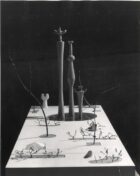
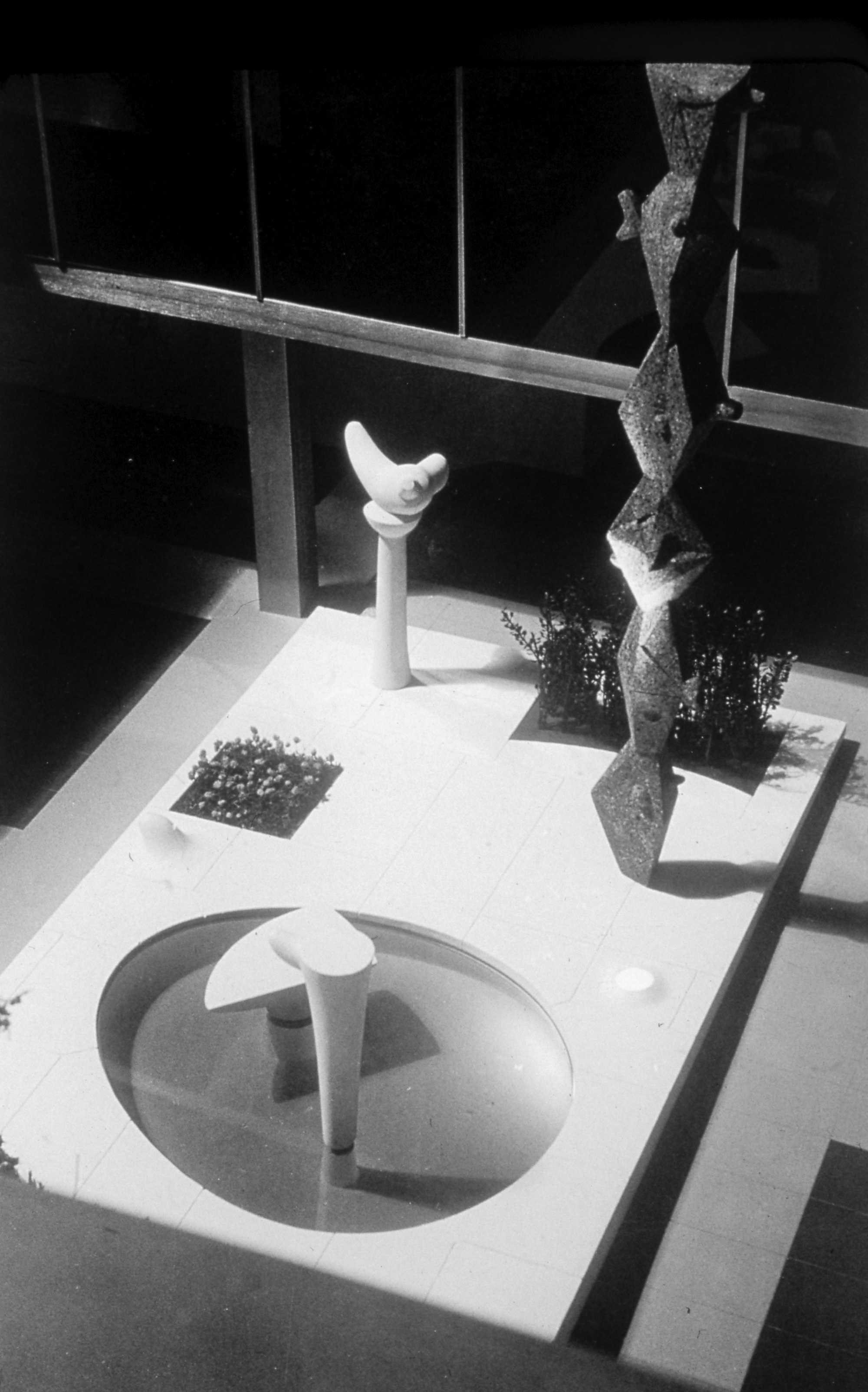
Though the work did not come to fruition, Lever House in New York (1951-1952) was the site of Noguchi’s first known collaboration with Bunshaft.7 Bunshaft was clear about why he brought in Noguchi: “We hoped to have sculpture integrated with the total design, including landscape, and Noguchi was the only sculptor that I knew of in the world who had the requisite knowledge of architecture, of plant material and space design….”8 The sculptures were to be set in the atrium on a raised stage or podium—Noguchi called it a “plateau.” We can assume its size, 50 by 50 feet, was roughly that of the garden later designed for the same space by SOM landscape designer Joanna Diman (1901-1991). It was outdoors—protected by the curtain wall of Lever House to the north, but open under the atrium towards Fifth Avenue to the east and 51st Street to the south. Two things are striking—firstly, the simplified character of the work: a rectangular architectural enclosure creating a kind of fence, open to the sky. In one of the models, the three columns are described by Noguchi as “effigies.” They stand in a circular pool of water.9 In the other model, Noguchi seems to have borrowed the idea of a great totem pole from his teacher Brancusi’s Endless Column (1918) in Târgu Jiu. Bird-like figures and a pool fill out the space. Just as architects like Le Corbusier (much admired by Bunshaft) sought to encourage architects to return to basic geometry, Noguchi seems to have brought sculpture back to its original ritual role alongside Bunshaft’s clean-lined architecture. The closest comparison may be Noguchi’s sets for the dance programs of Martha Graham with the sculptural figures accompanying the dancers. The Lever House plateau was, in its way, a kind of performance: abstract pre-human figures on a stage, enacting their ritual, enclosed by geometrical glass walls.
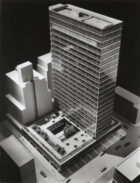
As completed by Diman, the atrium of Lever House has long had a different message: an empty plaza, its regularity determined by its window wall, modern in character. Emptiness is its content. Filled with Noguchi’s sculpture it would have been witty, a natural counterpoint to the roof garden above. Of course, Lever House did not need Noguchi to make a splash—but had his playful sculpture been installed, the kinds of criticism it later received (Frank Lloyd Wright called it “a box on sticks;” Charles Moore suggested that it needed soap bubbles floating up from a nearby fountain) would have been blunted. In an essay in the College Art Journal (1949) entitled “A Reintegration of the Arts,” Noguchi wrote about the importance of “public enjoyment.” Lever House with Noguchi’s sculpture would have offered just that. Its cancellation, ostensibly for financial reasons, reveals the limits of corporate artistic courage.10
Connecticut General Life Insurance Company Headquarters
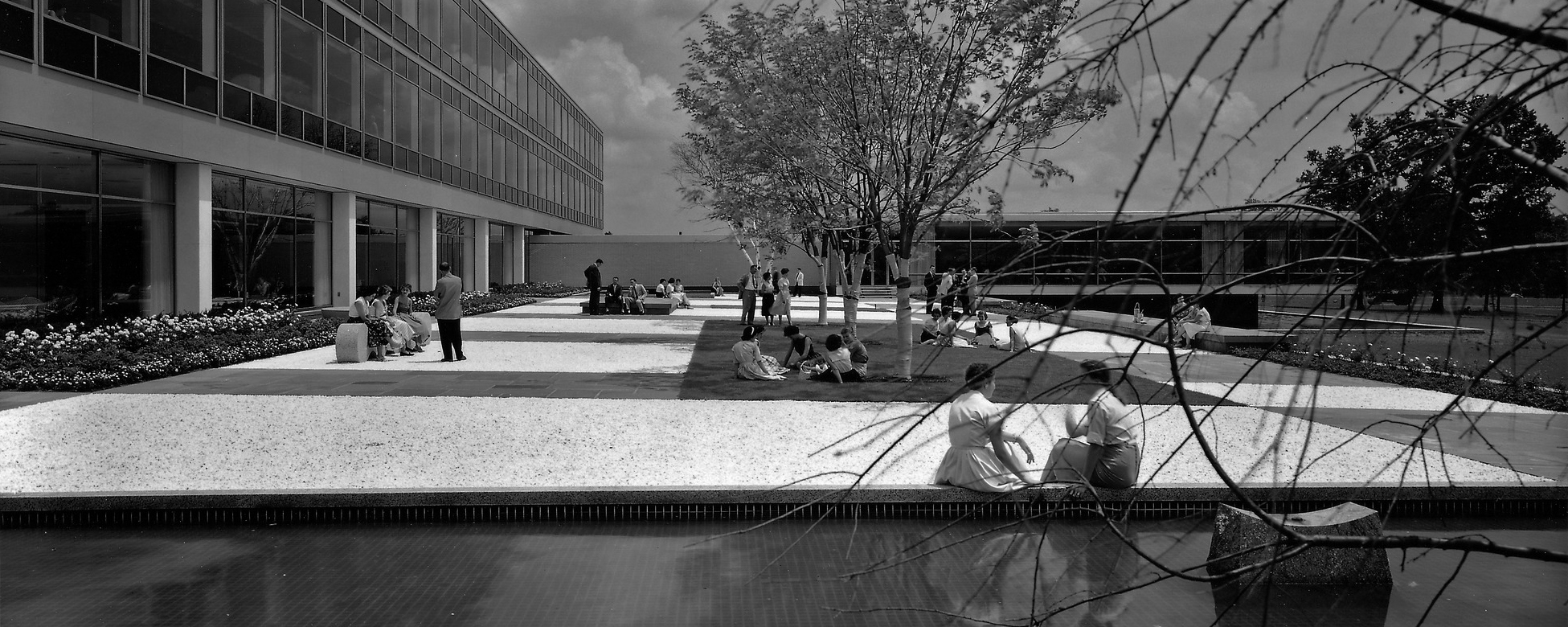
It might be imagined that the collapse of the Lever House project would have brought the relationship between Bunshaft and Noguchi to an end. It had the opposite effect. Almost immediately, Bunshaft brought Noguchi to work with him at Connecticut General, a rural corporate office in Bloomfield, Connecticut, outside of Hartford (1956-1957).11 The commission called on Noguchi to fill four interior gardens within a long, low, rectangular building broken along its length by atria that would provide daylight to the offices. The building was a bureaucratic conveyor belt with insurance policies moving along its length from desk to desk. The gardens offered breathing space—where staff could relax on break, where they could settle their eyes away from their desk. The staff was young and largely female, and making an attractive working environment was a key part of the program—not just in itself but as a way to retain the work force.12 Bunshaft made a neutral modern frame within which Noguchi could improvise curving abstract forms (again recalling Miró) alternating with reflective pools that caught the color of the sky. Noguchi’s low relief abstract beds (like slab sculptures on their sides) played against the right-angled glass walls. It was not just about humanizing the space (as many critics have noted) but about realizing the virtues of modernist reflectivity with which architects like Ludwig Mies van der Rohe, Bunshaft’s friend, also experimented; Noguchi was an essential contributor to the structure’s design.
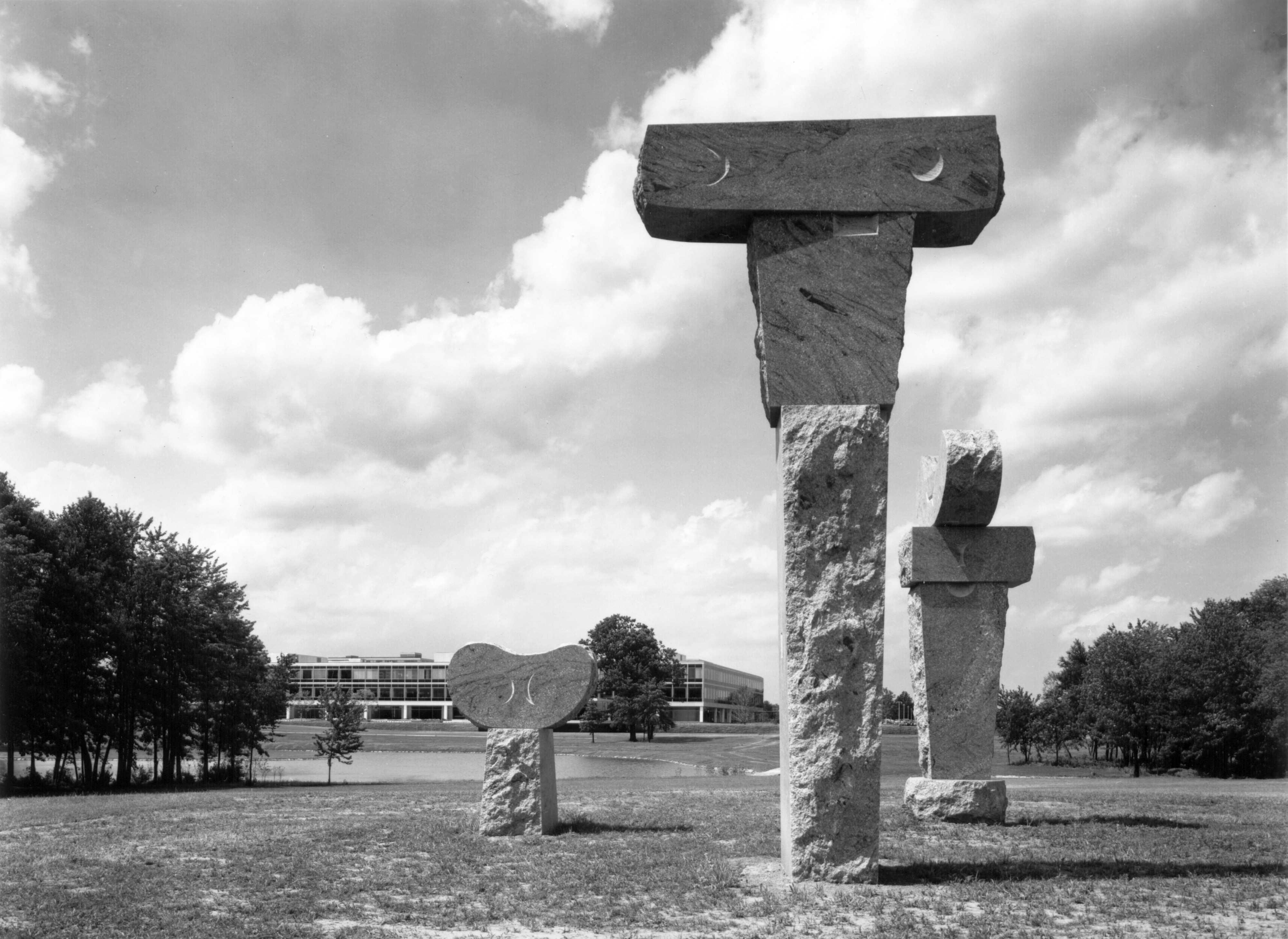
They also collaborated—after some testy discussion—on the new location for three abstract figures, a family group, originally planned for an outdoor terrace. In Bunshaft’s view, the location was “all wrong.” Who came up with the idea of trying them on a rise near the main building is not clear—probably either Noguchi or the client—but the results were more than satisfactory.13 The sculptures stood there until the sale of the Connecticut General site (then owned by CIGNA) in 2022. In describing the grouping, Connecticut General (with Noguchi’s or Bunshaft’s aid) emphasized that the sculptures were not a literal representation, but a group bearing “a certain relationship to the ancient stone monuments which are found in some parts of the world, notably in England.” Bunshaft visited Stonehenge many years later: “a moving and exciting experience. A magnificent work.”14
Around 1960-1961, a new idiom enriched their collaboration. In October-November 1960, Bunshaft and his wife, Nina, traveled Japan and South Asia accompanied by Noguchi.15 How the trip came about we do not know. Was it Bunshaft’s idea? More likely, Noguchi, who served as their guide much of the time, planned the itinerary. There was some work for them to do there—they visited Ise, for example, where they examined rock that would later be part of the garden for Chase Manhattan. One can imagine that Noguchi wanted to show Bunshaft the source of some of his ideas. It was not an easy trip for the testy architect. He found his hotel room in Tokyo small (like the dorm room he lived in at MIT) and their first meal with Noguchi was a shock: “Met Noguchi for a raw fish lunch called sushi. We had the works. Not again however.”
From Bunshaft’s diary, preserved in the Avery Architectural and Fine Arts Library, we know everything of note they saw. Bunshaft was (as usual) controlled in his responses: he does not express intellectual curiosity; he makes no note of history; but he clearly absorbs much. The high points in Japan were the temples at Nagoya and Ise where they saw the Shinto shrines. In Kyoto they visited the gardens (“all very beautiful”) and met a quarryman. They “saw a beauty for Chase.” At Angkor Wat, Bunshaft’s response was (comparatively) rapturous: “beyond what I expected. Really a truly great pile of stones.” In India he saw the Jantar Mantar telescope outside of New Delhi, as well as numerous temples and monumental sculptures. They even visited Chandigarh and met with Le Corbusier. Bunshaft does not disclose what he learned from the trip—there is no summary. But he saw the sources of many of the things Noguchi was proposing or would propose later. In short, he saw into the world on which Noguchi drew for his artistic vision, and this impacted their later projects.
IBM in Armonk
In the work they had done together hitherto, references to contemporary art predominated. Hereafter, the richly symbolic gardens developed at IBM (Armonk, NY) in 1964 and the Beinecke Rare Book Library at Yale University (New Haven, CT) in 1960-1964 resonate at another level. Perhaps most importantly, the garden at Chase Manhattan (New York) in 1961–1964, with its strong Japanese influence, is the major result of their Eastern trip. All three gardens, in the words of the art critic and friend of Noguchi, Dore Ashton, speak of the “modern and the ancient in the same breath.”16
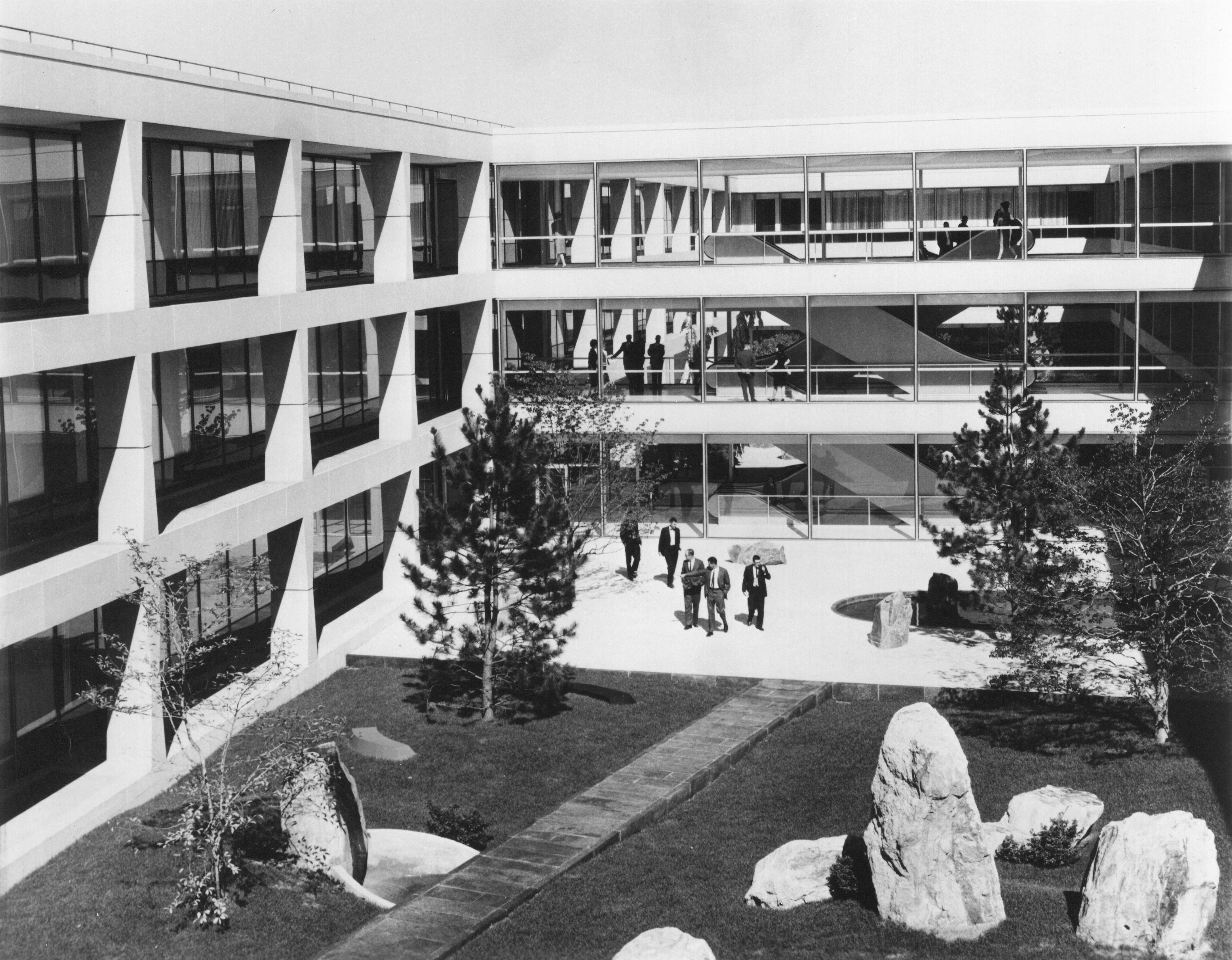
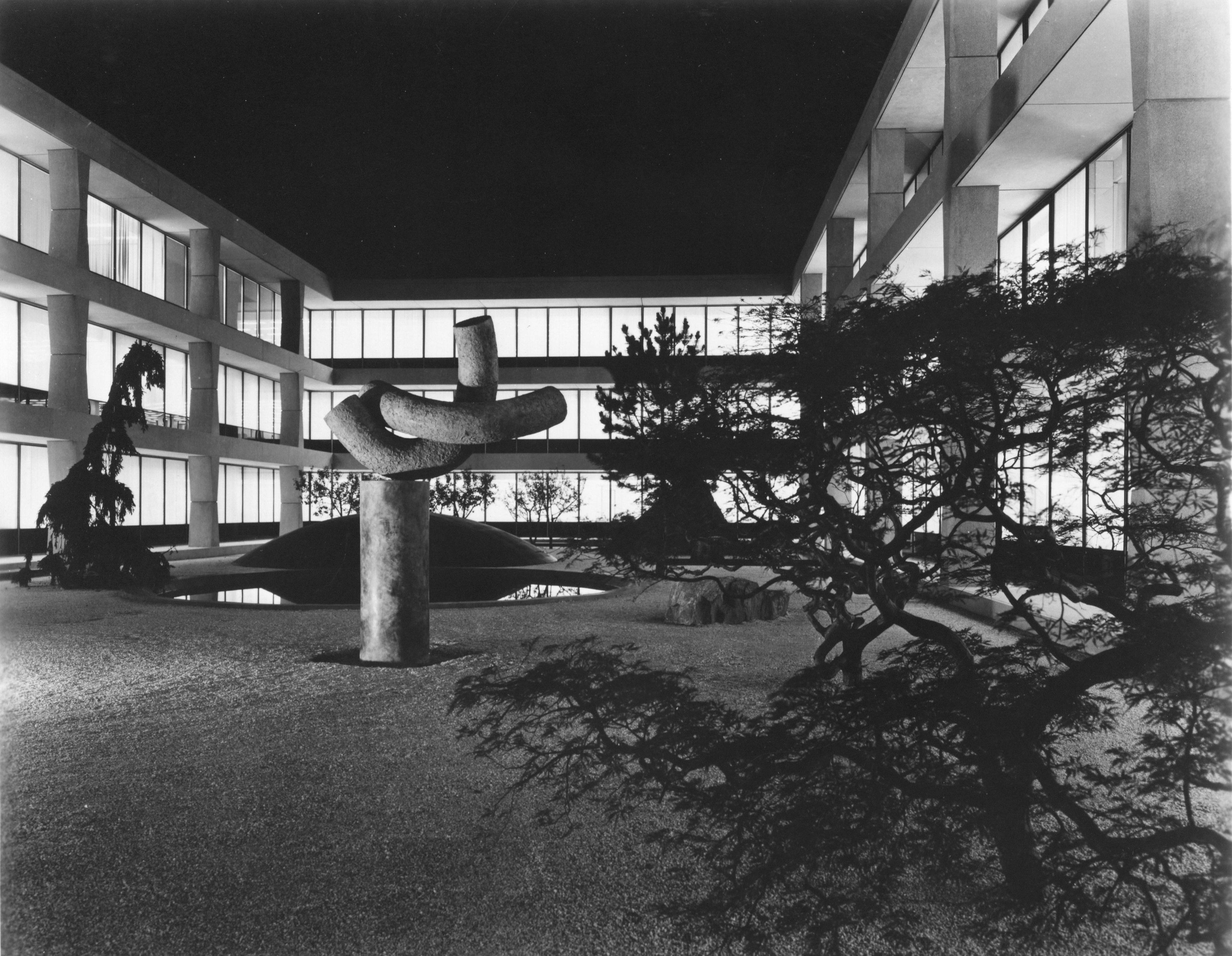
At IBM, Noguchi designed two gardens in a courtyard at the center of the building: a Garden of the Past and a Garden of the Future. To the south is a naturalistic Japanese garden with trees and boulders referring to the human past, “a pastoral setting [representing] the ages preceding the Industrial Revolution.” To the north side, humanity’s future is interpreted through science. An asymmetrical bronze sculpture with three cylinders represents the helical intertwining of the DNA molecule as the code of life that connects humans to their history. Additionally, a large red concave fountain, embedded in the earth, suggests (to Noguchi) a dish-shaped antenna monitoring the mysterious sounds in the universe. In the courtyard of the future, a black dome protrudes, its surface incised with equations relating to nuclear physics and astronomy. An asymmetric pyramid symbolizes atomic energy—an infinite source of power. The gardens provide a naturalistic meditative antidote (there are benches for seating) to the trellised geometry of the building; white piers anchor the space. A glass-walled bridge separates the gardens from the offices surrounding the courtyards. The architectural historian John Harwood has observed that employees crossing the bridge between the gardens perform “a daily ritual confirming the enduring presence of the corporate body”—the gardens as past and future, the building and the corporate body as the present.17
Beinecke Rare Book and Manuscript Library
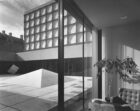
In the early 1960s, Bunshaft and Noguchi collaborated on two sunken gardens. At the Beinecke Library at Yale University, Noguchi created a garden in Hewitt Triangle in front of the library. To one side, dominating the plaza, is the white marble cube of the library; to the other sides are the classical columns of Memorial Hall and the rotunda entrance to Woolsey Hall.
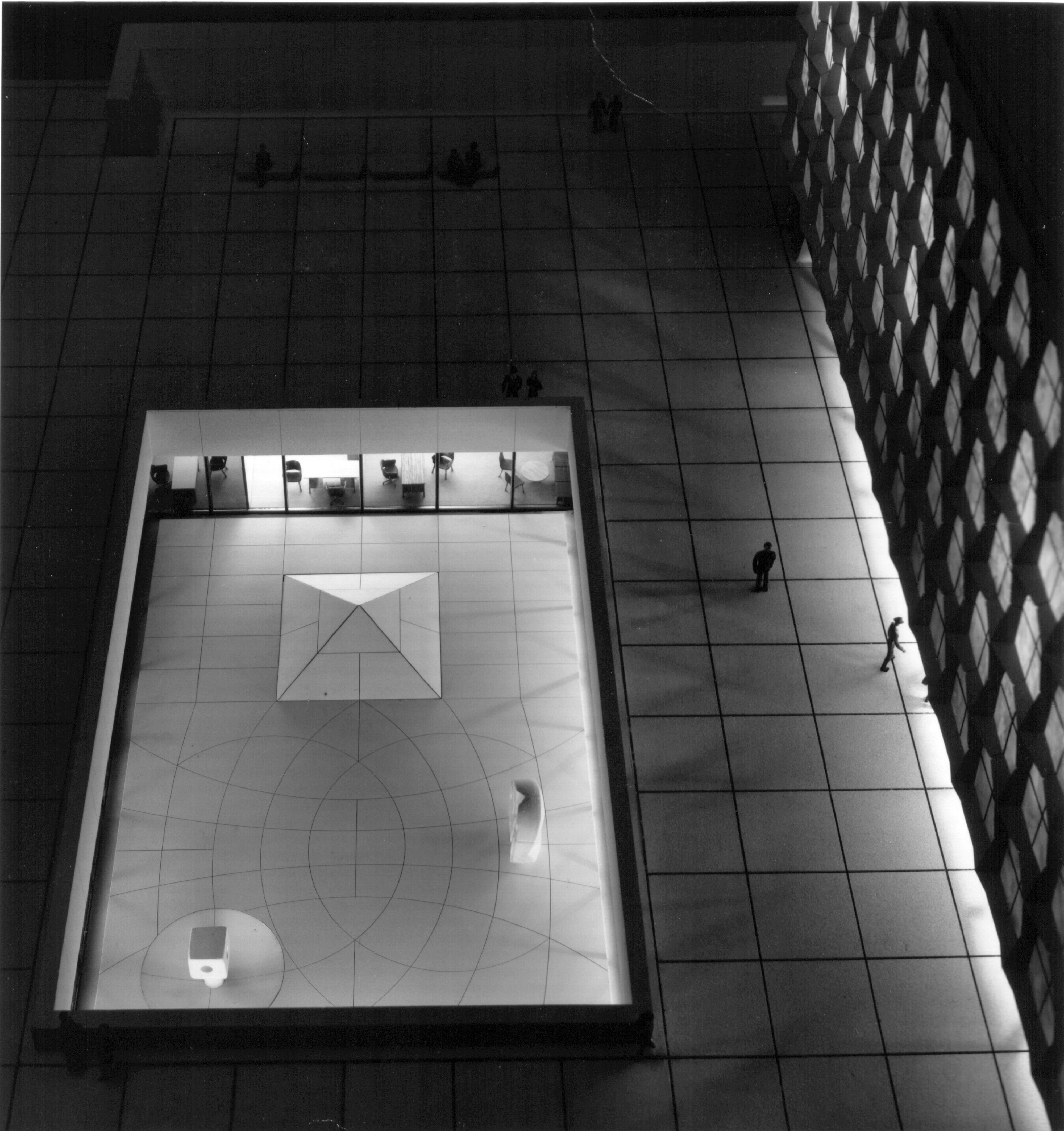
The sunken garden is for reflection and meditation; it is a dry garden without plants because it sits above library storage. It consists of a striated pavement of white Vermont marble and three marble forms: a pyramid, a cube balanced on one point, and a disc cut along one side. Their sources are eclectic: Japanese temples, eighteenth-century Indian astronomical gardens, and Italian paving. But the purpose, as at IBM, is to take the viewer on a journey to first principles; these are symbols relevant to the past and the future. Angle of view matters. From above, the objects appear as solids. From inside the library, the reflections in the dark glass around the courtyard repeat the solid forms, multiplying them in space. Solidity is dissolved into reflections. Noguchi expands on this variety of forms in his commentary: “the circle may represent the energy of the sun or a zero, the pyramid the geometry of the earth or the past, the cube on its point chance, or a man-made pile of carbon blocks by which he [man] has learned to stimulate nature’s processes.”18
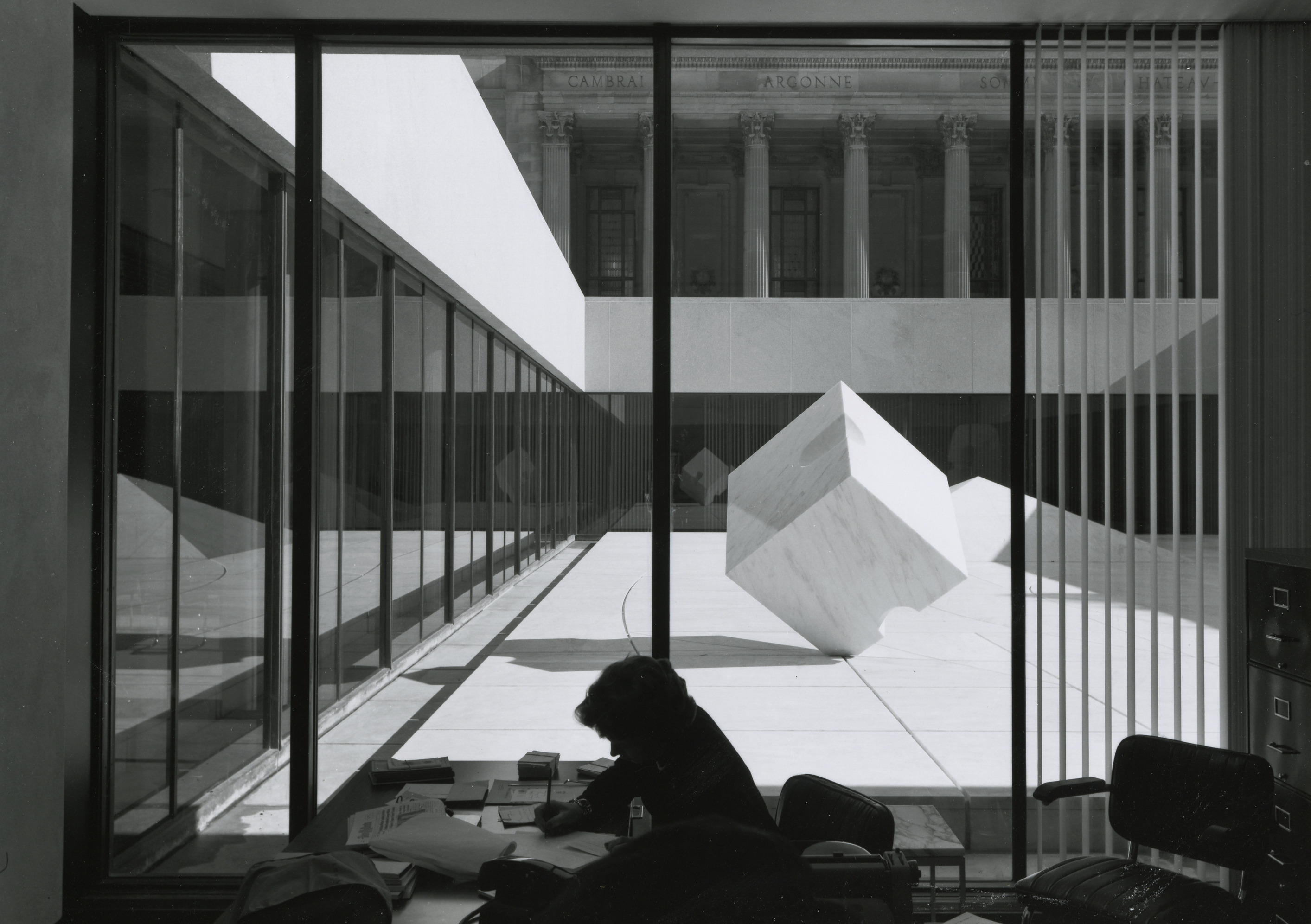
The garden also creates a remarkable dialogue with Bunshaft’s library and the glass tower of shelves and books, the essence of a library. Beinecke is not the classical library (circular body surmounted by a dome, volumes hidden from view); the glass tower displays the instruments of study. Garden and tower; modern abstractions and ancient learning are united. Was Bunshaft translating the prehistoric totem pole referenced by Noguchi into modern form?
One Chase Manhattan Plaza
The most strongly Japanese of Noguchi’s gardens for SOM is that underneath the Chase Manhattan Tower (1961-1964). Noguchi called it his Ryōan-ji—referring to the Zen Garden in Kyoto that he had taken Bunshaft to see. Building and garden had a lengthy gestation period. Bunshaft recorded consideration of Chase while he and Noguchi were in Japan in 1960. There were also problems on site. Lots had to be assembled, and rights of way closed, to begin the design of a building in the dense fabric of Lower Manhattan. SOM’s founder Nathaniel Owings had ambitions for this area that were sentimental in many ways. In his autobiography, Owings criticized the urbanistic character of the zone:19
All of those who are familiar with this area well know that the towering granite and stone structures that lie in crowded rows, in unbelievably narrow lanes, were laid out, for the most part, in pre-revolutionary times. Such street patterns require drastic measures to obtain the humanizing qualities and actual physical ease of access necessary to meet modern concepts of good planning.
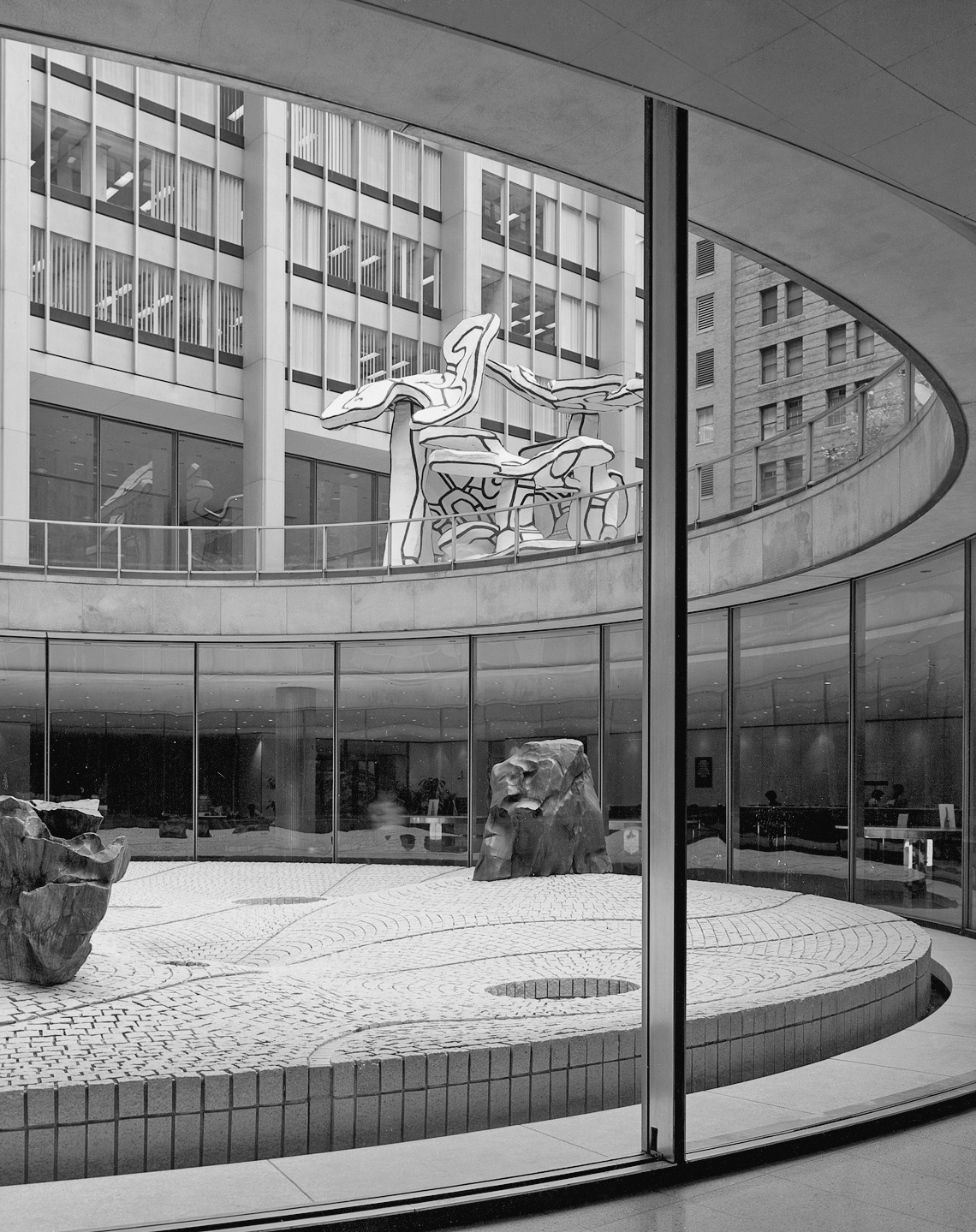
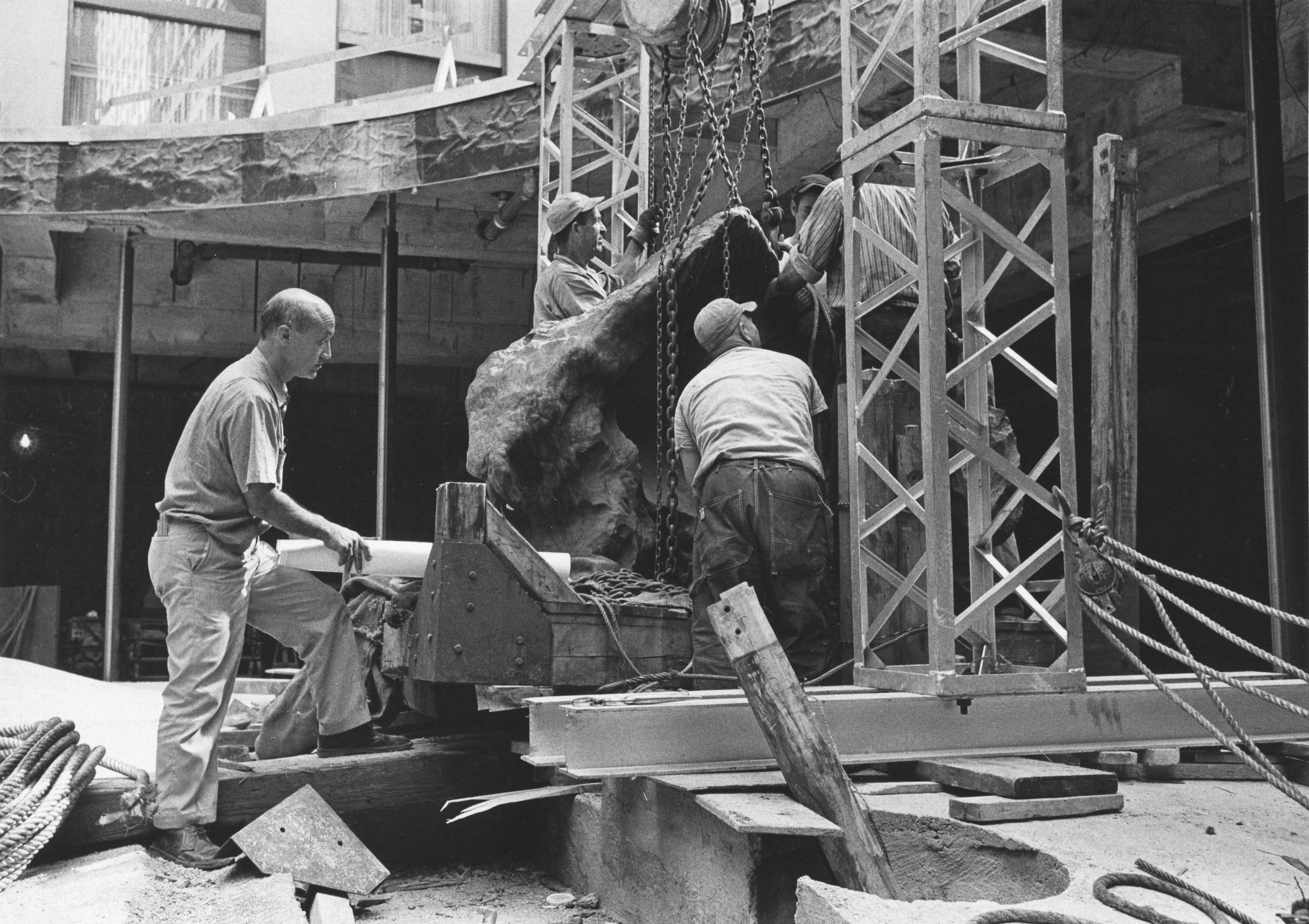
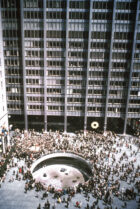
Owings’ aim was to recapture the feeling of a village. Partly on his insistence, it was agreed that 70 percent of the site would be left open; public sculpture would be welcome. David Rockefeller, president and chairman of the executive committee at Chase, who directed the construction program, was a leader in the movement to increase the presence of art in public space. The original plans consisted of an underground level garden and a large-scale sculpture at ground level: Alexander Calder and Alberto Giacometti were to engage with Noguchi in a competition. When plans for the sculpture were scrapped, Noguchi proceeded with the garden—still hoping to gain a sculptural commission. (Ultimately the commission was given to Jean Dubuffet). In building a lower-level garden, Rockefeller echoed the semi-underground open spaces at Rockefeller Center that his father, John D. Rockefeller, had built in midtown during the 1930s. Chase’s Garden was not a play space, however. It consists of a somber lower-level grotto and underground refuge: a garden with rocks weighing 1 ½ to 7 ½ tons, brought from Japan. During the summer months, jets of water flow over them. The underwater granite paving stones are broken by sinuous lines that both evoke and emphasize the movement of water. The rocks as islands and the sound of water form a key part of the effect. Noguchi also sought a wider resonance. In summer, the garden is refuge for a hot and busy city, a welcoming architectural underground, a place for contemplation. From above, the circular opening in the plaza has planetary echoes: it evokes earth and its geology, a sun or a moon, and the rocks as spots or craters within the vortices of the paving.20
First National Bank and John Hancock Life Insurance Building
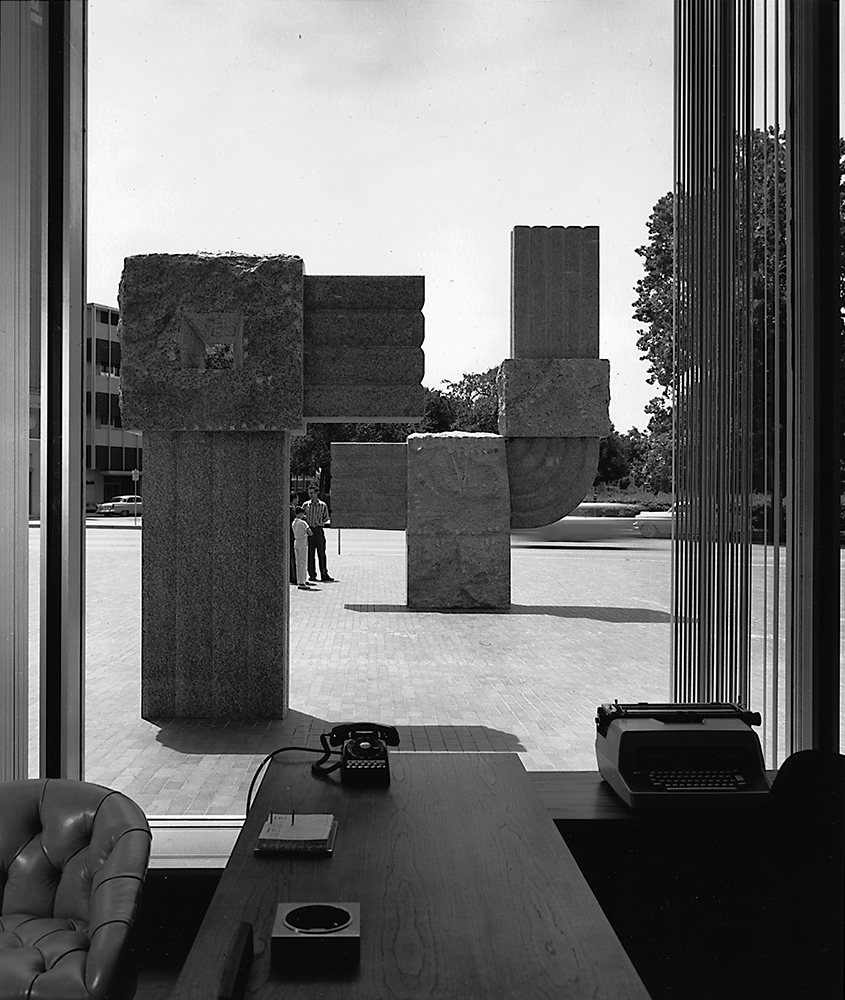
Noguchi also collaborated on the placement of sculpture near two of Bunshaft’s buildings. A group of three sculptures make up Texas Sculpture (Fort Worth, Texas) 1960–1962, which Bunshaft placed on the plaza in front of SOM’s First National Bank. One of the forms symbolizes energy (the dollar sign); the other is a figure of man. Noguchi comments somewhat poetically: “The loneliness of symbols,” a suggestive comment that reminds us that Noguchi’s father was a fine modernist poet.21 The stone came from Japan, and Noguchi worked on it there before shipping it to New York City. Mississippi Fountain, 1961-1962, made of stone from Minnesota, is located on the plaza in front of the John Hancock Life Insurance Building, New Orleans (now K&B Plaza). It consists of a roughly carved fluted column supporting a crescent-shaped capital that alludes to the “Crescent City,” the nickname of the city of New Orleans. Water, so important in the life of the city, flows from the capital down the sides of the column. Both complexes offer an attractively condensed symbolism.
Marine Midland Building
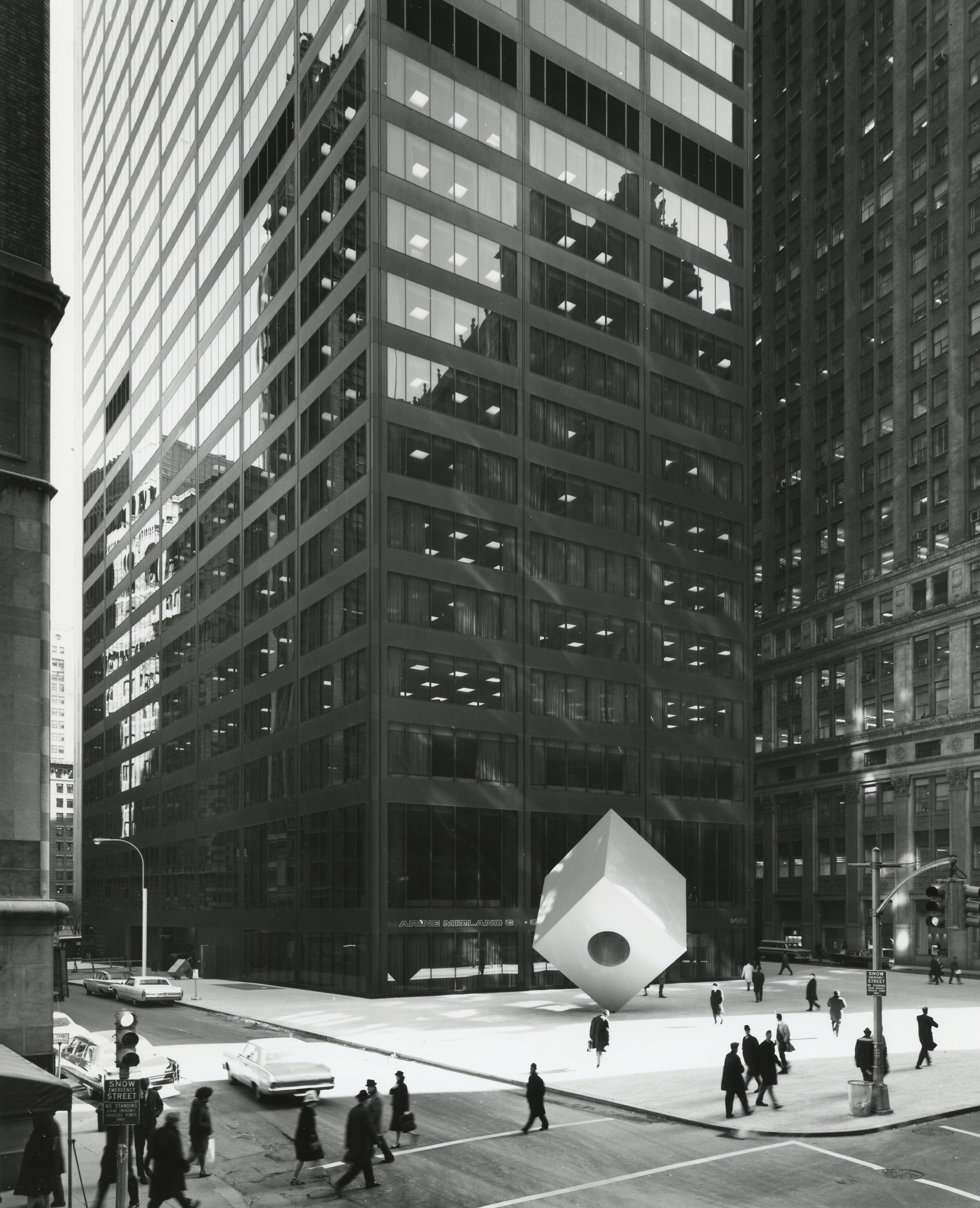
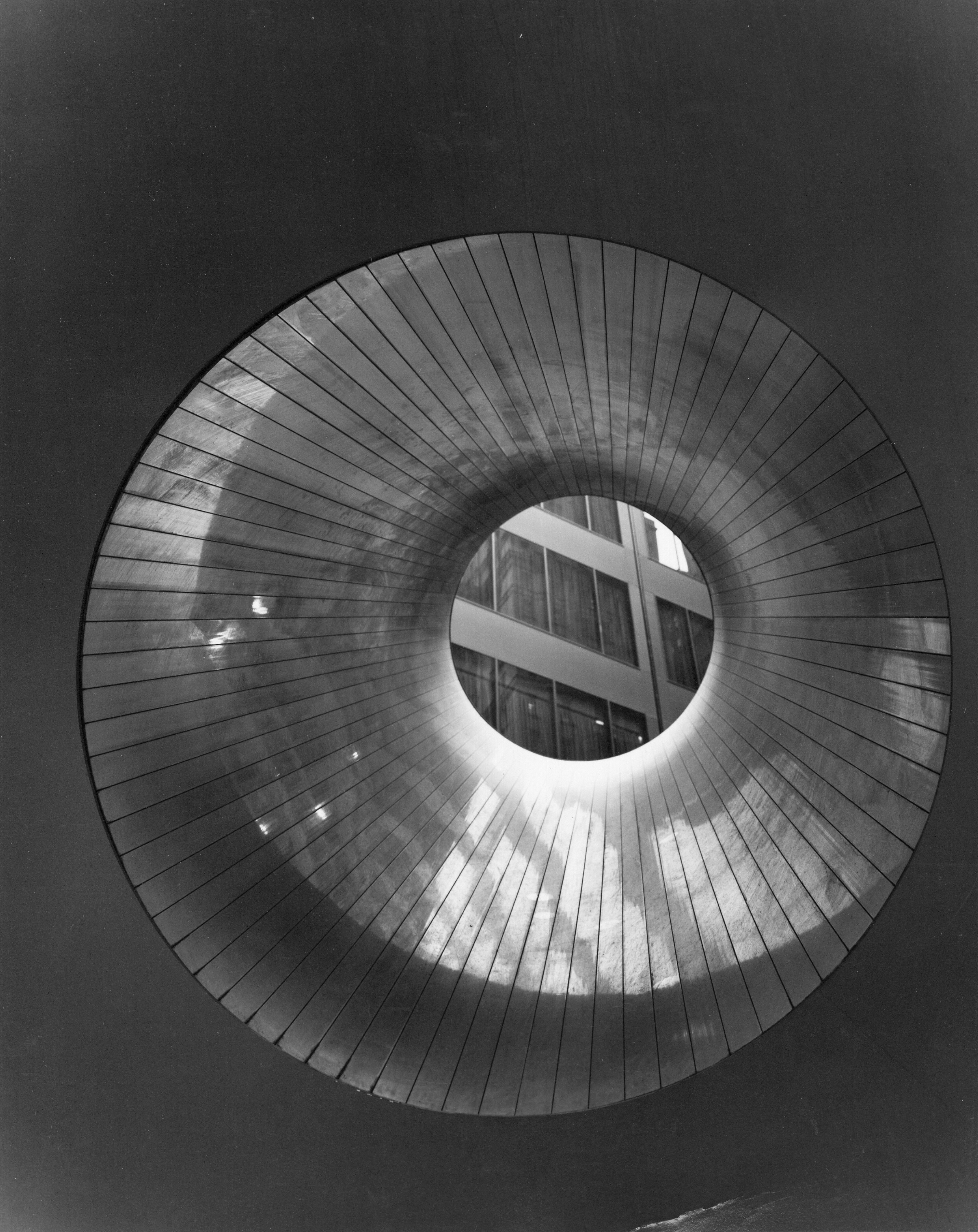
One of Noguchi’s freestanding sculptures is particularly significant, not just for its urban prominence, but because it looks wholly different from his other work for SOM. Red Cube (1967) sits in front of the Marine Midland Bank Building (later HSBC), now generally known as 140 Broadway (1964-1968). On a street of gray and black horizontals and verticals, the 24-foot-high, Technicolor-red rhombohedron standing on one corner provides a radical alternative of diagonals. Through the middle of the sculpture is a hole directing the view upwards.
Red Cube has a bold urban presence. The surroundings were carefully studied. According to the developer, Harry Helmsley, the proposal for sculpture came initially from Bunshaft. He and Helmsley looked at alternatives, ultimately selecting the steel rhombohedron. But in Bunshaft’s account, he and Noguchi initially worked on a stone megalith (recalling their trip to the Far East) before moving to metal: first a series of small red objects scattered around the plaza, and finally the 16-by-16-foot cube. The experience was a powerful one for Bunshaft—almost as if he had been a partner in the final design. He chose the scale with a kind of confidence that might have offended the sculptor.22 It was “Bunshaft’s” sculpture.
What does Red Cube mean? Is it just about the experience of space? At the Beinecke, Noguchi had used a balancing cube and described it there as referring to “chance.” Does the work refer to the precariousness of life—or to the precariousness of all things? Its effect is both personal (at the level of the pedestrian) and urbanistic (at the level of the buildings), both personal and universal.23 The critic Arthur Drexler has suggested that the tight surfaces of the SOM building look like packaging, with interior space as the commodity. He compared the flat, dark-on-dark of piers and glass of 140 Broadway to an abstract painting by Ad Reinhardt (1913-1967). The effect is to render the building as much sculptural as it is architectural (and to make the sculpture as much architectural as it is sculptural). Travertine paving links building to sculpture. For Drexler, paving and sculpture transposed “the empiricism of architecture into the metaphysics of abstract form.” Are what we see “perfect forms deteriorating towards earthly imperfection, or imperfect forms aspiring to the Platonic ideal”? 24 In the opinion of the architectural critic Ada Louise Huxtable, the tension between two and three dimensions, between surface and space, solid and void, plaza and tower, make Red Cube one of Bunshaft’s and Noguchi’s most successful collaborations.25
A monumental collaboration
Bunshaft and Noguchi formed a remarkable partnership, though work was not always smooth. Bunshaft acted as the client to the sculptor, directing the work, and Noguchi was willing to find different registers to make the partnership work. (Alcohol may have lubricated—and complicated—their times together.) On the one hand, Noguchi disparaged sculptors like Henry Moore and David Smith, who disdained the idea of compromising with an architect. Noguchi sought a more flexible role. “I have come to feel,” he wrote in 1968, “that sculpture can only be of significance to architecture and to the space of human environment as something conclusive to that space.”26 Materials and thematic strands—or what he did yesterday or last year—were irrelevant to the commission. When they visited sculptors, architects were generally not offered different strategies. Noguchi reports Moore saying, “‘Alright, which one and how big?’” Noguchi took a riskier path, offering the architect a say in his creative work, an opportunity no one else offered Bunshaft. He had wanted to be an artist from the beginning, and this was his chance—not exactly being a sculptor, but inhabiting the role. At Beinecke Library, Bunshaft noted, “We didn’t talk about what it should be, but had he come up with something lousy, I would have told him so.” And Noguchi recognized the reason for architects’ uncertainty: “They are afraid of something that might ruin their building, and I think they’re justified from experience, because sculpture has usually been slapped onto a building for no good reason at all.”27 On the other hand, Bunshaft had been Noguchi’s primary sponsor and it was his “persistence that saw them realized.” The architect’s determination had “squeezed out whatever was in me.”28 Does that explain why there was nothing after Red Cube? “[O]ne runs one’s course,” Noguchi reported dourly in 1968, the year of the completion of Red Cube, implying that they had reached an ending: “I mean, after all, architects are vain people and, if they feel you’re competitive with them, they don’t want you around anymore. So that was the end of that.”29 As a person and as an architect, Bunshaft was generally oblivious to others and their feelings; whatever the circumstances, he declared himself top dog. Later, he commented that Noguchi had presented his own problems. Bunshaft had had to be a “nursemaid…. He’d come in and say, well, I’m not getting enough money or going to quit, you know, and all that stuff. If he did it to me now, I’d say ‘good-bye.’ He was a very difficult man to work for.” 30 At this distance there is no truth to be found between their positions. They were lucky to have survived one another for a dozen years and to have produced such extraordinary works.
It is commonplace to criticize modern architecture, and notably the buildings of Gordon Bunshaft, for what is perceived as their lack of acknowledgment of site. All of the examples discussed above prove the reverse. They fulfill post-war ambitions for a modern, humanized monumentality that would capture the symbolic as well as the practical needs of society. The partnership of Bunshaft and Noguchi, whatever its practical difficulties, set a standard for artistic cooperation between sculptor and architect: ambitious, meaningful, and enduring.
Nicholas Adams is the Mary Conover Mellon professor of architectural history emeritus at Vassar College. He is the author of Gordon Bunshaft and SOM: Building Corporate Modernism (Yale University Press, 2019). He also wrote the first independently authored study of the firm, Skidmore, Owings & Merrill: SOM since 1936 (Phaidon, 2007).
Notes
-
For example: Alexander Calder, Joan Mirò (Cincinnati), Joan Miró, Chryssa (Chicago), Louise Nevelson (San Francisco), Elynn Zimmerman (Washington, DC), Philip K. Smith, Robert Graham (Los Angeles), Arnaldo Pomodoro (Des Moines), Danny Lane (Detroit), Stuart Davis (Pittsburgh), Richard Serra, Sol LeWitt, Jonathan Borofsky (Toronto), Stephen Cox, Danny Lane, Philip Jackson (London), Jaume Plensa (India), Jeff Koons, Martin Puryear (China).
-
For example, “Modern Sculpture for Architecture,” Architectural League of New York, December 11, 1947–December 22, 1947.
-
Anson Conger Goodyear (1877–1964) helped initiate a number of important exhibitions at the Albright Museum (as it was then called) in Buffalo. Noguchi suggests the connection may have been the furniture maker Hans Knoll, but provides no details: Oral history Interview with Isamu Noguchi, 1973, Nov. 7-Dec. 2, 58, Smithsonian Archives of American Art
-
At meetings, too, Bunshaft would doodle Mirò-like organic shapes on meeting agenda sheets at SOM. These are now located among the Bunshaft Papers in the Archives and Special Collections, Avery Architectural and Fine Arts Library, Columbia University.
-
As reported by Saburo Hasegawa in “Days with Isamu Noguchi,” originally published in 1950. “He often talks about the great Dadaist Marcel Duchamp. He also loves to talk about Brancusi, his sculpture teacher, as well as Mondrian, Klee, and Miró.” The Saburo Hasegawa Reader, ed. Mark Dean Johnson, Dakin Hart, Matthew Kirsch (University of California Press, 2019), 81.
-
Kouros was exhibited Fourteen Americans exhibition at the Museum of Modern Art, 1946. Bunshaft’s wife, Nina Wayler, was a dancer and he might have been introduced to Noguchi’s work that way.
-
“Oral History of Gordon Bunshaft,” interviewed by Betty J. Blum. (Chicago Art Institute, 2000), 175.
-
Interview with Gordon Bunshaft conducted by Martin Friedman, “Noguchi’s imaginary Landscapes,” Design Quarterly, no 160/107 (1978), 47.
-
In a dispute about costs dated 16 October 1951 Noguchi describes the three figures standing in the pool as “granite sculptural columns” and later as “effigies.” See Noguchi Museum archive.
-
Ultimately the space was filled by raised rectangular gardens designed by SOM’s landscape specialist in those years. See Nicholas Adams, “Joanna C. Diman (1901–1991): A “Cantankerous” Landscape Architect at Skidmore, Owings & Merrill,” Journal of the Society of Architectural Historians 77 (September 2018), 339–48. It is worth stating that Natalie de Blois only claimed that she worked on the design of the plaza, the cafeteria, and the first three floors of Lever House. See de Blois, “Timeline of Projects,” prepared by Nicholas Adams, SOM Journal 4 (2006): 158–159. The senior design partner at Lever House was Emanuel Turano (1917–1977).
-
[1] At the same time (1956) Nathaniel Owings attempted to hire Noguchi to provide a garden for the Crown Zellerbach tower in San Francisco. Noguchi’s proposals were rejected by Chuck Bassett, and Noguchi was fired. There is a lot going on here. Since Lever House (and Bunshaft’s claims for total authorship) Owings was resentful––“stealing” his sculptor was a way to get back at Bunshaft. Owings was thwarted by Bassett. See Oral History of Edward Charles Bassett, Interviewed by Betty J. Blum (Art Institute of Chicago, 2006), 79–83.
-
See Joe Alex Morris, “It’s Nice to Work in the Country,” Saturday Evening Post, 5 July
1958, 21, 70-72. The company also subsidized bus lines, carpools, and created extensive after-hours activities (theater, chorus, sports).
-
In this connection between viewer and landscape Noguchi realized the concept of shakkei (landscape captured alive), see Ana Maria Torres, Isamu Noguchi: A Study of Space (Monacelli 2000), 95, n. 28.
-
Bunshaft, Travel Diary (1974), 18 June 1974. Avery Architectural and Fine Arts Library, Bunshaft Papers, Boxes 16 and 17.
-
Quotations are from Bunshaft, Travel Diary (1960).
-
Dore Ashton, Noguchi East and West (University of California Press, 1992), quoted in Dakin Hart, Isamu Noguchi Archaic/Modern (Smithsonian American Art Museum, 2016), 16.
-
John Harwood, The Interface: IBM and the Transformation of Corporate Design 1945–1976 (University of Minnesota Press, 2011), 131.
-
Isamu Noguchi, A Sculptor’s World (Harper & Row, 1968), 170-171.
-
“Basic Concepts—Chase Manhattan—Skidmore, Owings & Merrill, Architects-Engineers,” 13 March 1956, SOM (New York) Marketing department files. One wonders if Bunshaft, who for many years maintained his indifference to context had not responded to the position of someone like Paul Rudolph? Speaking before the AIA Convention in Boston in 1954, Rudolph praised the urban fabric of Europe. Man, he said, “used piazzas, courtyards, squares, freestanding sculptures, manipulating the approaches, and sequences of space.” Paul Rudolph, “The Changing Philosophy of Architecture,” Architectural Forum 101 (July 1954), pp. 120-121. Quotations from p. 120.
-
Noguchi, A Sculptor’s World, 171-172.
-
Noguchi, A Sculptor’s World, 169.
-
For Bunshaft’s opinion, see Bunhshaft, Oral Memoir, at the Avery Architectural and Fine Arts Library, Bunshaft, 102; Harriet F. Senie, Contemporary Public Sculpture: Tradition, Transformation, and Controversy (Oxford University Press, 1992), 77–78. Carol Krinsky, Gordon Bunshaft of Skidmore, Owings & Merrill (Architectural History Foundation, 1988), 163.
-
Valerie J. Fletcher, “Isamu Noguchi: Master Sculptor” in Fletcher, Isamu Noguchi: Master Sculptor (Hirshhorn Museum and Sculpture Garden, 2005), 138.
-
Arthur Drexler, “Introduction” to SOM 1963–1973, 20. See also Michael Sorkin, “American Architecture since 1960: Quo Vadis,” in American Architecture After Modernism, ed. Robert A.M. Stern, A+U (March 1981, extra edition), 26. Eric P. Nash, Manhattan Skyscrapers (Princeton Architectural Press, 2010), 119.
-
Ada Louise Huxtable, “Sometimes We Do It Right,” NYT, 31 March 1968, Section D, 33.
-
Isamu Noguchi, “The Sculptor and the Architect,” in Noguchi: Essays and Conversations, ed. Diane Apostos-Cappadona and Bruce Altschuler (Harry N. Abrams and The Isamu Noguchi Foundation, 1994), 50. Originally published in Studio International 176.902 (1968), 18, 20.
-
“Bunshaft and Noguchi: An Uneasy But Highly Productive Architect-Artist Collaboration,” Journal of the American Institute of Architects 65 (October 1976), 54.
-
“Bunshaft and Noguchi,” 52. See also Noguchi, A Sculptor’s World, 172.
-
Oral history Interview with Isamu Noguchi, 59.
-
Gordon Bunshaft, undated lecture presentation with Paul Weidlinger, ca. 1987. Skidmore, Owings & Merrill, New York, Archives.