This article, authored by Senior Associate Principal and Sustainability Director Mina Hasman and Partner Adam Semel, appears in our 2025 Impact Report. Since its publication, Adam helped launch Ourea Energy, a startup developing a unique energy infrastructure platform that packages energy storage, thermal energy management, and water security, built to last for generations via hyper-local workforce and community investment.
Today’s energy systems face unprecedented strain from three converging forces: rising demand driven by electrification and AI-enabled digital growth; geopolitical instability that threatens supply security; and climate change, which intensifies both demand and disruption. Energy is, therefore, not only a climate challenge, but a question of security, resilience, and affordability—of how cities absorb shocks, adapt, and continue to function.
Energy realities differ dramatically across the world, and cities are at the forefront of the crisis. In the Global North, data center growth and the rapid electrification of transport and buildings is colliding with grids strained by intermittency, peak loads, and aging infrastructure. Extreme weather events expose vulnerabilities in systems designed for a different era. In the Global South, explosive urban growth means that baseline demand for reliable, affordable energy remains unresolved, even as climate impacts often arrive earlier and more intensely. In both contexts, energy systems built for predictable, centralized generation are being asked to do more, faster, and under harsher conditions.
The implications are clear: decarbonization must be designed for growth and adaptability, not just efficiency.
A critical but under-acknowledged fact is that energy consumption, after decades of relative stability, is accelerating again. In the United States, electricity demand remained largely flat for nearly 30 years as efficiency gains in buildings, vehicles, and appliances offset growth. That era is ending. Projections now suggest the grid may need to expand dramatically—potentially doubling in capacity over the next 15 years—as electrification, cooling demand, data centers, and AI workloads surge. Globally, energy demand rose by 2.2 percent in 2024, while electricity demand increased by 4.3 percent, with more than 80 percent of that growth coming from emerging and developing economies, a fact that underscores both the scale and uneven geography of rising demand.
The implications are clear: decarbonization must be designed for growth and adaptability, not just efficiency. Resilience requires planning for peak loads, redundancy, flexibility, and disruption. As cities densify and digital ecosystems expand, demand will keep rising—and it cannot be treated as a footnote.

Energy transition, resilience, and affordability must be addressed together. Architects, engineers, and urban designers play a critical role by embedding energy considerations into urban form—reducing demand through passive design, enabling distributed systems, and integrating adaptability at district and campus scales.
At Xiong’an, China’s Millennium City, we master-planned a 3,800-hectare development envisioned as an exemplar of net-zero, nature-centered urbanism—leveraging natural systems to reduce energy demands in a city designed to endure for a thousand years and remain affordable to the working class.
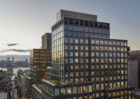
In New York, the SOM-designed headquarters for The Walt Disney Company is notable as the city’s first all-electric headquarters building. Packing a dense collection of television studios, newsrooms, offices, and outdoor spaces into a single Manhattan block, the building is equipped with a sophisticated system of water-source heat pumps that provide energy-efficient heating. The building design anticipates a more sustainable power grid. Once the city transitions to entirely renewable power—New York’s 2040 goal—the headquarters will become a net-zero-energy building. Similarly, projects such as the Princeton University Meadows Neighborhood, City of Appleton Public Library, and the Mulva Cultural Center integrate ground source heat pump systems—effectively thermal batteries storing lower-exergy energy on site—strengthening local resilience, while also reducing stress on centralised grids. These approaches reflect a broader shift toward institutions “bringing their own energy” to ensure continuity.
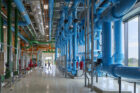
Energy storage sits at the center of this transition. Storage—both electrical and thermal—is essential for grid stability, renewable integration, urban resilience during outages and extreme events, and affordability during peak demand. Yet a major gap remains between building-scale solutions and national infrastructure. City-scale storage becomes a spatial, infrastructural, and governance challenge. In the PJM Interconnection, the largest U.S. grid, long-term forecasts show sharp peak-demand growth driven largely by data center expansion. During extreme cold in late January 2026, PJM operated near record demand, with prices briefly exceeding $3,000/MWh, compared to a real-time load-weighted average of roughly $52/MWh in early 2025—illustrating how quickly affordability can collapse under stress.
SOM’s exploration of gravity-based storage through our ongoing partnership with Energy Vault® responds to these challenges—not as a single solution, but as part of a broader inquiry into long-duration, city-scale storage as urban infrastructure. Gravity systems add value by decoupling storage from critical mineral constraints and short-duration cycling. Resilient urban energy systems will rely on diverse, layered approaches, particularly as projections suggest AI-related data centers could account for around 10 percent of global power-demand growth over the next decade.

Moreover, energy resilience is not evenly distributed. Outages and price shocks disproportionately affect vulnerable populations. Without intentional planning, resilience is too often considered a premium feature rather than a baseline. City-scale strategies—such as shared infrastructure, distributed systems, and equitable cost allocation—can support more inclusive access to reliable energy.
Ultimately, the success of the energy transition will be measured not just in emissions reduced, but by reliability, affordability, resilience, and equity of the grid. Designers have agency to shape systems that work under stress, not just on paper. This is not about predicting the future—it is about designing cities with the capacity to adapt, endure, and thrive amid uncertainty.