The Alatau Iconic Complex and Gateway District is designed to support long-term growth and opportunity in the Almaty region through a resilient, site-specific, and transit-oriented approach.
Positioned within the new city of Alatau—a flagship project for Kazakhstan set to become a Central Asian international hub—the SOM-designed Iconic Complex and Gateway District will serve as the city’s economic and administrative nucleus.
Located along the Almaty-Qonaev highway, a key section of the Western Europe-Western China transport corridor, Alatau is planned to span 88,000 hectares across four districts. Strategically positioned to enhance regional connectivity, economic development, and innovation, the new city will link Almaty with Central Asia and beyond.
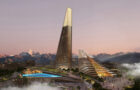
At the centre of this vision, SOM’s Iconic Complex forms a 276,800-square-meter vertical district defined by a pair of gateway towers. Integrating office, residential, hospitality, retail, and cultural programmes, the development establishes a dense, mixed-use urban core for the emerging city. Inspired by the surrounding Trans-Ili Alatau—a 350-kilometre range of valleys, glaciers, and stratified terrain—the design translates these local natural formations into architecture, creating a unique identity rooted in the Kazakh landscape.
Rising 272 meters, the primary tower will accommodate office space and premium residences, becoming the tallest structure in the Almaty region and southern Kazakhstan upon completion. An adjacent 80-metre tower with a luxury hotel and branded residences reinforces the district’s mixed-use intensity. Both buildings feature high-performance façades and integrated shading strategies to reduce solar gain, while central atria draw natural light deep into the floorplates and frame panoramic views of the surrounding mountains.
At the base, a three-level podium of 58,000 square meters anchors the complex. Echoing the local foothills of the Alatau, it terraces toward the public realm, accommodating retail, cultural venues, and event spaces while fostering active pedestrian engagement.
The project draws on SOM’s global expertise in designing landmark tall buildings—including the Burj Khalifa in Dubai, One World Trade Center in New York, and Jin Mao Tower in Shanghai— towers that redefine skylines while advancing structural and environmental innovation. This experience informs both the design and engineering of the Iconic Complex, ensuring it becomes a defining symbol of Alatau City.
The region’s high seismic conditions drive the project’s integrated architectural and structural design. Structural resilience is embedded in the architecture, with seismically resilient framing and damping systems—proven in high-seismic regions such as Japan and Taiwan—that dissipate earthquake energy and ensure long-term safety and post-disaster functionality.
The surrounding Gateway District leverages SOM’s international planning expertise, prioritizing walkability, density, and multimodal transportation. Planned express rail and Light Rail Transit (LRT) corridors position the district as a regional transit hub, while green boulevards, shaded streets, and public plazas foster a human-scaled urban experience. The project also integrates advanced micromobility infrastructure, including provisions for Electric Vertical Take-Off and Landing (eVTOL) aircraft, alongside pedestrian and transit networks, to ensure the city is connected at every scale.
The project is led by the Alatau City Development Group LLP alongside long-term investors and government partners supporting Alatau as a strategic national initiative. Once complete, the Iconic Complex and Gateway District will form a vertically integrated, mobility-oriented, and culturally attuned urban heart of Alatau, setting a new benchmark for city-making in Kazakhstan and across Central Asia.
About Skidmore, Owings & Merrill (SOM)
Skidmore, Owings & Merrill (SOM) is a global practice of architects, designers, engineers, and planners, responsible for some of the world’s most technically and environmentally advanced buildings and significant public spaces. The firm’s approach is highly collaborative, and its interdisciplinary team is engaged in a wide range of international projects, with creative studios based across the globe. The firm’s portfolio includes numerous innovative landmark towers, including the Burj Khalifa in Dubai, One World Trade Center in New York, and Jin Mao Tower in Shanghai, as well as large-scale urban planning initiatives that integrate density, mobility, and sustainability—including the award-winning Sultan Haitham City in Muscat, Oman, and the recently unveiled masterplan for Bradfield City, Australia’s first new city in more than a century.