Project
University of North Carolina Genome Science Building
Chapel Hill, North Carolina, United States
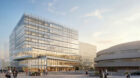
Located on The Hong Kong University of Science and Technology (HKUST) campus in Clear Water Bay, this new building marks the beginning of the university’s medical school program and supports the launch of its curriculum.
In November 2025, HKUST was chosen by the HKSAR Government through a rigorous selection process to establish Hong Kong’s third medical school, marking a significant milestone for both the university and the city. The initiative reflects the government’s ambition to strengthen Hong Kong’s role as a global center for science, technology, medical research, and innovation.
As the first dedicated facility for the discipline on campus, the new Medical Education and Research Complex brings together teaching, research, and collaborative spaces in a single academic hub, establishing a physical and symbolic foundation for the university’s growing program. While conceived as an advanced environment for medical education, the facility also supports the school’s longer-term trajectory, with plans for future relocation to a purpose-built campus in Hong Kong’s Northern Metropolis.
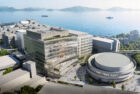
Sited in the southern portion of campus, the Medical Education and Research Complex serves as both an anchor and gateway in HKUST’s broader master plan. In tandem with Shaw Auditorium, it frames a central public plaza, which connects to the south-most end of a major pedestrian thoroughfare, and provides a gathering space for students, faculty, and visitors.
The building’s geometry mirrors the rounded shape of the auditorium, reflecting the buildings’ complementary purposes and reinforcing the plaza as a vital civic space on campus.
The establishment of Hong Kong’s third medical school is a significant moment for the city, and this building is designed to reflect that ambition. In dialogue with Shaw Auditorium and the plaza, its form, cascading terraces, and transparent academic spaces create a visible culture of learning and exchange—positioning the Medical Education and Research Complex as an open, connected, and public-facing part of university life.
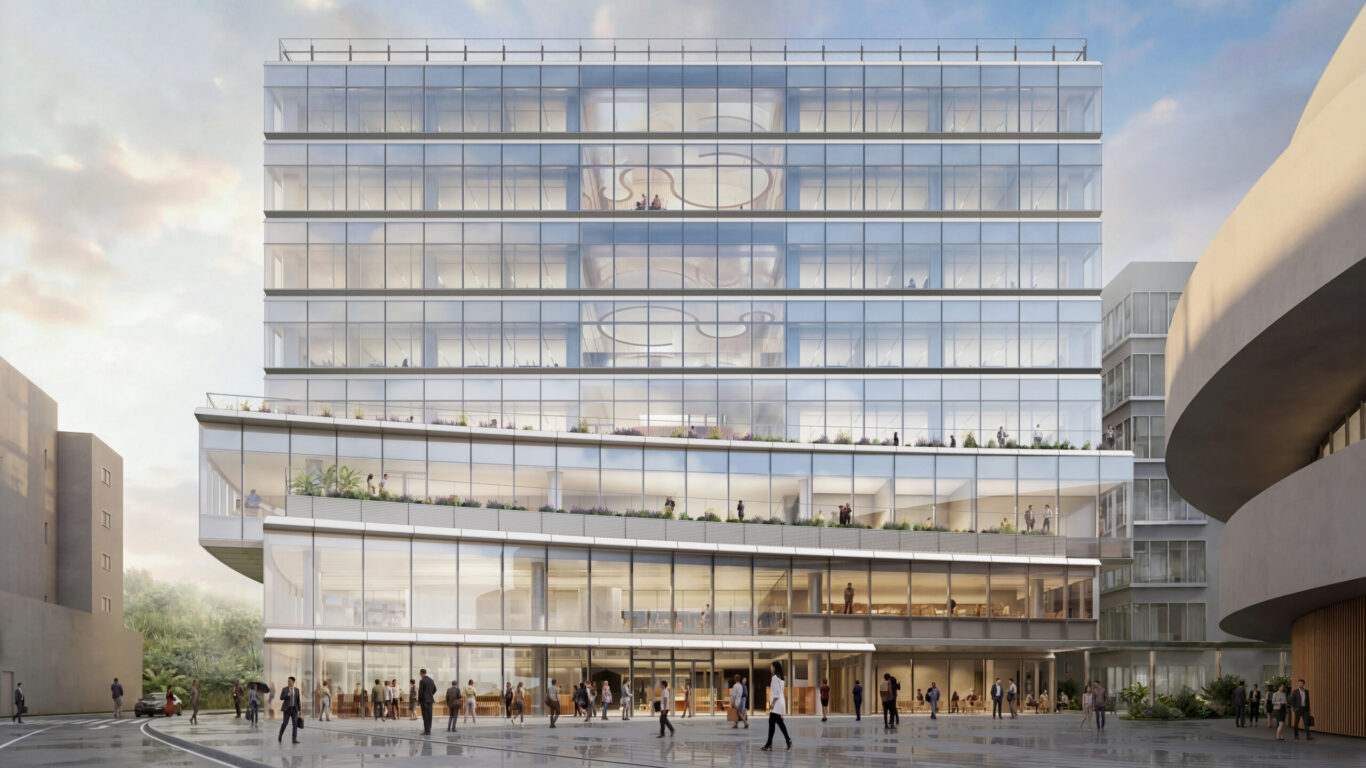
The new building brings together research laboratories, classrooms, faculty offices, and communal learning environments within a clear organizational framework—with a three-story podium base and five-story tower above. The podium houses the building’s most accessible functions, including an auditorium, library, cafeteria, classrooms, and presentation spaces.
Above, the tower houses faculty offices, classrooms, and laboratories, organized into two distinct research communities, each with its own central connecting stair. This vertical arrangement creates focused environments for research while maintaining proximity and visual connections. Throughout the building, exposed glass elevators animate connections between the spaces, making movement visible and encouraging interaction among students, faculty, and researchers.
The ground-floor lobby, together with two large atria on the third and sixth floors, forms the social and intellectual heart of the building. Designed as flexible, collaborative environments, these spaces extend the energy of the plaza, drawing daylight deep into the interiors and providing welcoming spaces for informal learning.
On the south side, a large amphitheater spanning levels three and four is designed to accommodate lectures and presentations. Its tiered seating offers views out onto the terrace and Shaw Plaza. Landscaped terraces, connected to the library and upper office levels, extend these areas outdoors, providing informal study and meeting spaces, opportunities to gather in the open air, and vantage points over the plaza for celebrations and events.
In all three atrium spaces, clusters of soft seating provide adaptable settings for informal meetings, discussion and collaborative work. Throughout the building, offices and laboratories face into the atria and shared spaces, reinforcing visual and spatial connections between research activity and the broader life of the community.
Partnering with HKUST is an opportunity to design more than just a medical school building—it’s about creating a living laboratory for the future of medicine. We’ve focused on ‘putting science on display’ through open intellectual hubs that encourage collaboration. By prioritizing flexibility, we’re ensuring this building remains a resilient, adaptable home for the breakthroughs of tomorrow.
The building’s architectural expression reflects its role as a place of discovery. Conceived as a jewel-like glass cube, the facade emphasizes transparency, putting the activities of teaching and research on display. This design is distinct from the more opaque ceramic-tiled architecture elsewhere on campus, establishing a strong identity for the new medical school.
Carefully calibrated for energy efficiency and performance, the building provides an optimal environment for lab, office, and collaborative work. A high-performance envelope of low-emissivity glass encloses the structure in a refined, continuous surface, while large facade panels create expansive windows that maximize daylight and outward views without compromising thermal performance. Discreetly integrated operable panels enable natural ventilation when conditions permit—enhancing occupant comfort and reducing energy demand in Hong Kong’s subtropical climate—without impacting the building’s seamless elevation.
Flexibility is integral to the project’s long-term value. While designed to support the launch of HKUST’s medical program, the building’s layout can adapt to serve evolving academic needs. This approach is significant given the school’s planned future relocation to the Northern Metropolis, where a permanent medical campus and teaching hospital will be developed. Teaching spaces, laboratories, and offices are configured to allow for future reorganization, ensuring the facility can accommodate new uses and continue to support the university’s strategic development over time.
Chapel Hill, North Carolina, United States
Storrs, Connecticut, United States
01/