Shanghai West Bund Convention Center

  • Client Shanghai West Bund Exhibition Center Co., Ltd
  • Expertise Civic + Government
  • Location Shanghai, Shanghai, China

Designed with an innovative AI-assisted workflow, this convention center fits major exhibition and public spaces within a compact site. It is the main conference venue in a Shanghai district that has emerged as a tech industry hub.

Project Facts
  • Status Construction In Progress
  • Completion Year 2026
  • Design Finish Year 2023
  • Size Site Area: 2 hectares Building Height: 49.70 meters Number of Stories: 7 Building Gross Area: 60,000 square meters
  • Collaborators ECADI - East China Architecture Design and Research Institute
Project Facts
  • Status Construction In Progress
  • Completion Year 2026
  • Design Finish Year 2023
  • Size Site Area: 2 hectares Building Height: 49.70 meters Number of Stories: 7 Building Gross Area: 60,000 square meters
  • Collaborators ECADI - East China Architecture Design and Research Institute

A riverfront venue for West Bund

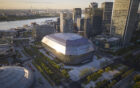
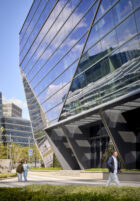
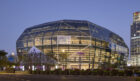
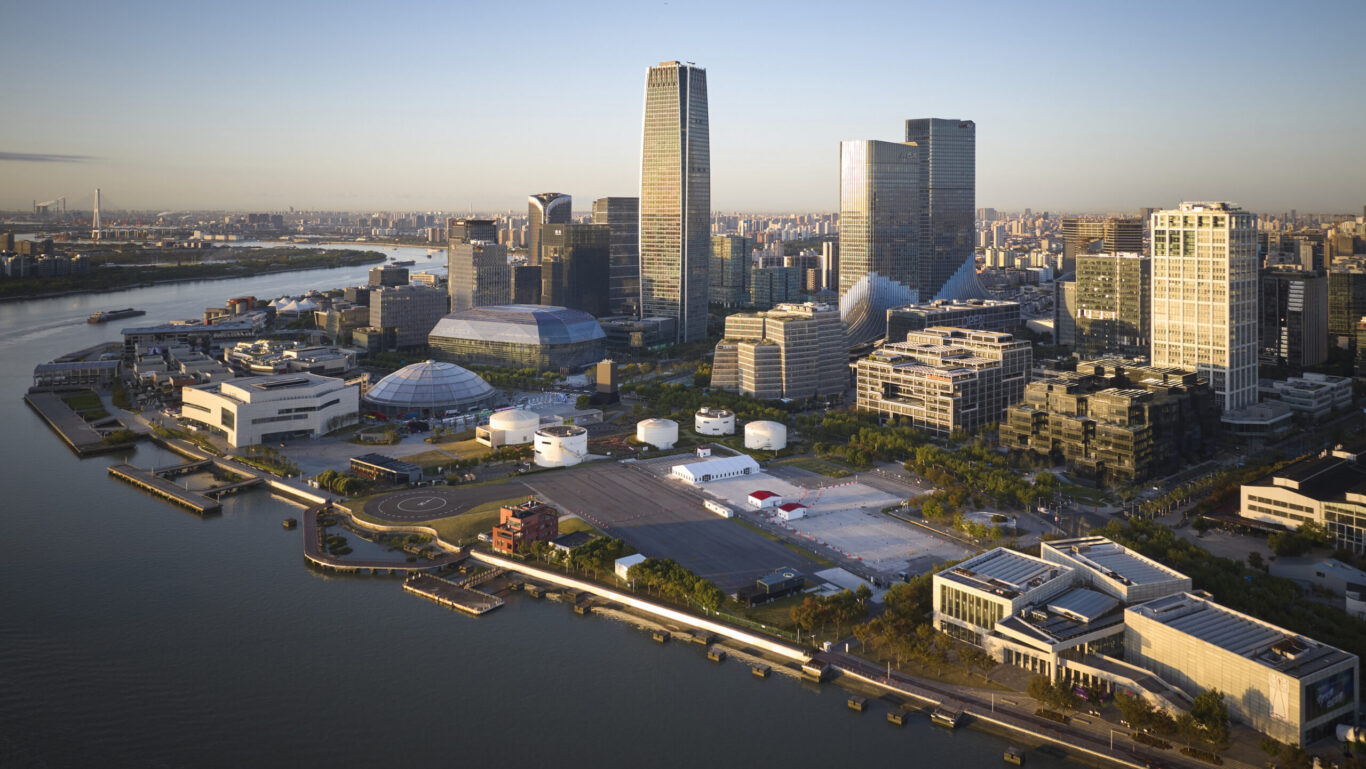
Positioned along the Huangpu River, the West Bund Convention Center contributes to a Shanghai district dedicated to culture and a growing artificial intelligence sector. The team’s design process—incorporating an AI-assisted workflow—reflects the emerging identity of the neighborhood. The vertical massing consolidates a wide variety of programming within a small footprint, while preserving much of the ground plane for public space. Landscaped terraces and river-facing promenades extend the district’s five-kilometer green corridor, strengthening connections between the waterfront and nearby cultural institutions.
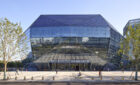
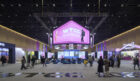
In July 2025, the convention center hosted the World Artificial Intelligence Conference on its ground floor. Built with low-carbon materials and energy-efficient systems, the project reinforces West Bund’s identity as an innovation hub.
Dave Burk © SOM

Advancing design through AI

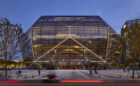
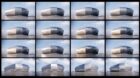
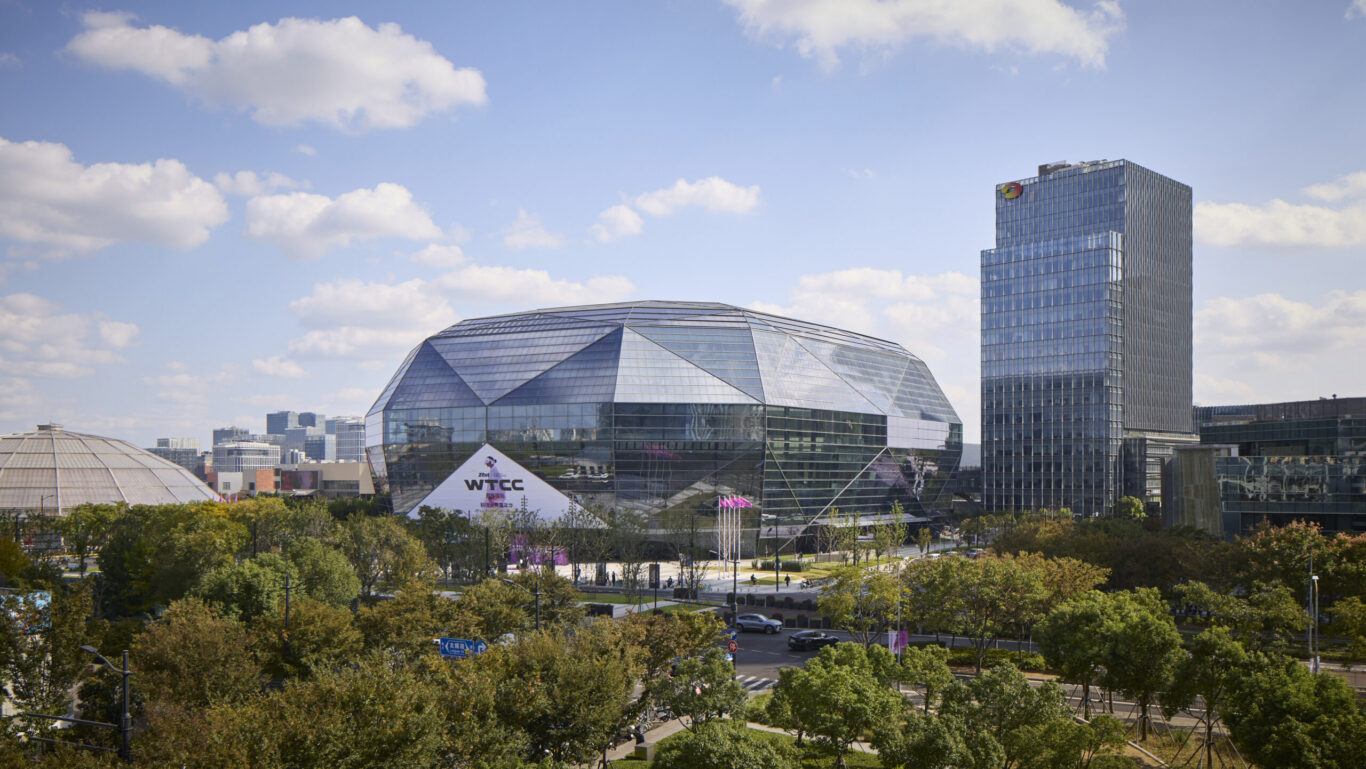
The project continues SOM’s history of innovation in computational design. An AI-assisted, multi-objective optimization workflow guided the building’s diamond-inspired geometry, balancing parameters including daylight and shading, floor area and envelope inclination, and structural efficiency and view orientation. The design team defined spatial boundaries, programmatic requirements, curtain wall conditions, and performance objectives. Algorithms then generated and evaluated hundreds of models, each scored against the criteria established by the architects and engineers.

© SOM

This process accelerated early-stage research and enabled a level of precision difficult to achieve manually. It also expanded the range of possible configurations that would meet the project’s technical and experiential goals. Human judgment remained fundamental: designers selected and refined the preferred iteration based on contextual fit, clarity, and elegance. The workflow reduced structural steel quantities, improved energy performance, and achieved the facade’s complex geometry using a largely standardized set of glass panels—significantly reducing project costs.

Dave Burk © SOM

Taking the convention center vertical

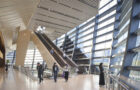
The design and layout makes the most of the building’s limited footprint. A tall atrium anchors the primary entrance, where a sequence of escalators brings visitors to two large, column-free halls of 6,000 and 4,000 square meters. Among the largest spaces of their kind along the waterfront, these halls accommodate international conferences, expos, and community programs. Their vertical placement maximizes the amount of available space, while improving circulation and wayfinding.

Dave Burk © SOM

Perimeter public spaces, meeting rooms, and gathering areas receive abundant natural light and frame views of the river. Landscaped terraces on the upper levels offer outdoor rooms that expand the building’s event capacity and extend the district’s network of open spaces.

Dave Burk © SOM

More Projects

01/