The Gateway – Dubai Creek Harbour Metro Station

A luminous addition to Dubai’s skyline, The Gateway blends transit innovation with civic purpose. Its layered design, public plaza, and sustainable features transform the station into a vibrant hub for transit, community engagement, and architectural expression.

Project Facts
  • Status Design Complete
  • Size Site Area: 96,500 square meters Building Height: 74 meters Building Gross Area: 10,800
Project Facts
  • Status Design Complete
  • Size Site Area: 96,500 square meters Building Height: 74 meters Building Gross Area: 10,800

A state-of-the-art transit hub and civic connector

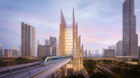
For the Dubai Metro’s new Blue Line, the Roads and Transport Authority commissioned SOM to create a bold architectural statement, anchoring the city’s expanding transit network. Strategically located in Dubai Creek Harbour, the three-level, 10,800-square-meter station is set to become the world’s tallest metro station, reaching 74 meters in height. Designed to accommodate up to 160,000 daily commuters by 2040, it supports the goals of the national Dubai 2040 Urban Master Plan.

The Gateway reflects Dubai’s vision for a more connected, resilient, and sustainable future. Its design incorporates passive environmental strategies, high-performance materials, and efficient transit operations to support long-term urban and climate goals. More than a transit hub, it reimagines the metro station as a civic destination, a vital part of the public realm and a symbol of Dubai’s innovative infrastructure evolution. 

The state-of-the-art structure is one of fourteen new stations, along 30 kilometres of track—and extends Dubai’s Blue Line with an elevated extension that crosses Dubai Creek, allowing more access to mass transit for the city’s eastern neighborhoods. It integrates multiple transit systems, including trains and buses. 
© ATCHAIN

An awe-inspiring design for a new community in Dubai

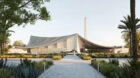
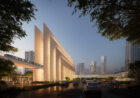
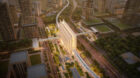
The Gateway is strategically positioned as an anchor in a growing neighborhood, flanking a primary highway and offering optimal pedestrian access to key destinations: the business district to the east, a retail mall to the west, and a residential community to the north. The station draws aesthetic inspiration from Dubai Creek—a historic waterway renowned for fishing, pearling, and its role as a gateway for local trade and transport. The modern design features a mirrored set of walls of varying heights, evoking the rhythm and layering of waterfront architecture. During the day sunlight moves across the facade’s natural jura limestone cladding. By night, the stone’s translucency transforms the station into a luminous urban landmark, fitting as an entry point to this dynamic new district.

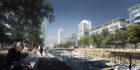
A transit plaza welcomes patrons with a lush landscape that frames pick-up and drop-off zones, parking areas, and pedestrian walkways. Retail and food-and-beverage offerings—including small kiosks, boutique shops, a farmer’s market, and a food truck plaza—serve the daily needs of travelers. Anticipated arts and cultural amenities, including a sculpture park, rotating art installations, pop-up cinemas, and performance space, aim to foster community engagement. 

The Gateway’s design prioritizes seamless transit flow and universal accessibility to create an intuitive experience for all commuters. Beyond train and bus travel, it integrates functional zones for bike rentals, electric scooter parking, and EV charging—supporting a diverse, sustainable mobility network.


Modern interiors fit for a major transit hub

Inside, the station is designed to support a smooth and intuitive commuter experience across three primary levels: ground, concourse, and platform. The eastern entrance connects to the new transit plaza, while a footbridge links the station to nearby retail development. On the west, an elevated pedestrian bridge offers access to a nearby retail mall.

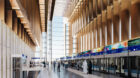
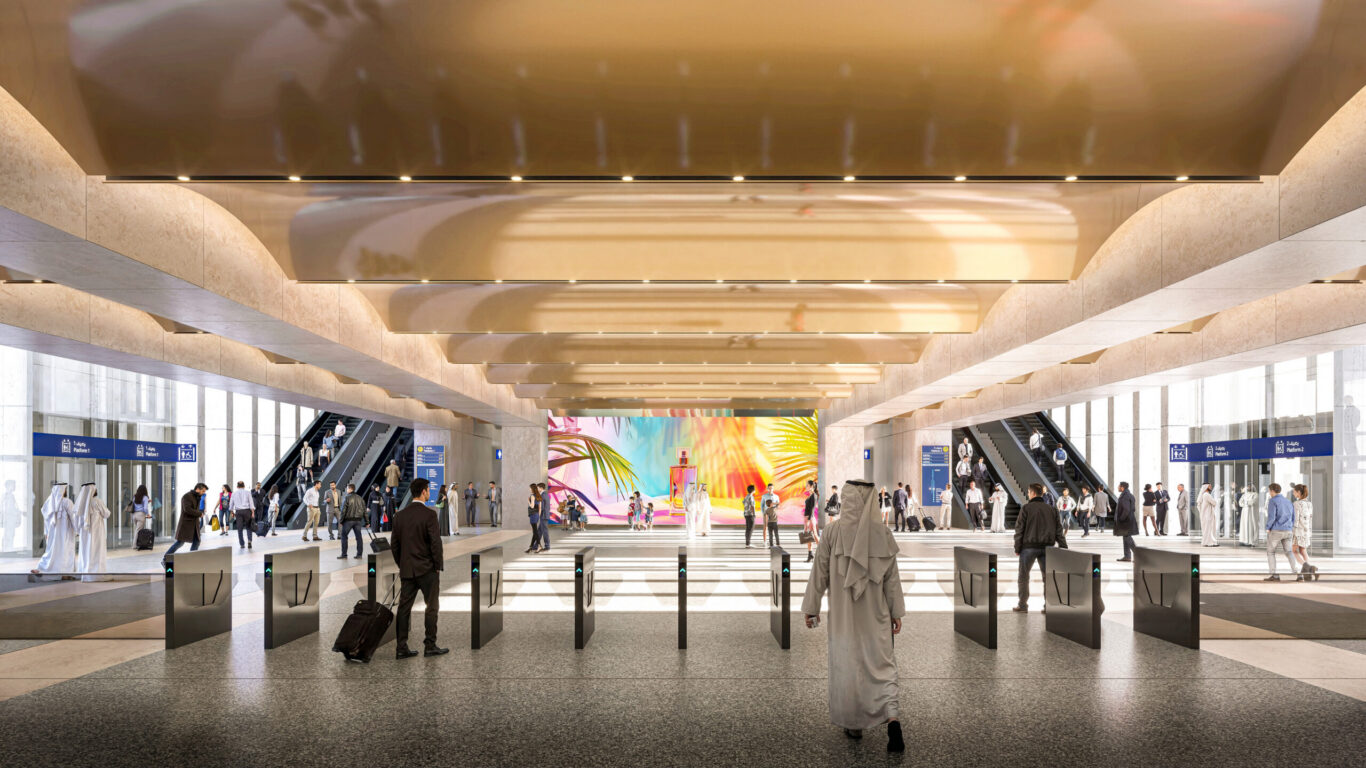
The concourse level offers ample natural light, with retail amenities that enhance the commuter experience. After passing through the turnstiles, visitors ascend to the platform level—a spacious, light-filled environment. 

The interior is framed by shading louvers and a glass enclosure, accented with oil-rubbed bronze finishes. Towering limestone walls, rich in natural texture and earthy hues, evoke a deep connection to the region’s geography. Refined metal details add sophistication and a grand aesthetic emblematic of Dubai’s architectural identity.


Sustainable features for a modern architectural landmark

Sustainable design and green spaces are at the forefront, reflecting SOM’s commitment to environmental responsibility and community well-being. The Gateway employs passive water-based systems to conserve energy, complemented by a holistic environmental strategy that integrates air, light, thermal comfort, acoustics, ecology, and projected climate patterns. Passive design innovations are maximized through this integrated approach. Sensor-controlled heating and cooling systems adjust in real time based on occupancy levels, reducing energy loads during peak and off-peak periods.


A model for future mobility

As a key link in the expanding Dubai Metro network and a central element of the Dubai 2040 Urban Master Plan, The Gateway is designed to meet the demands of a growing city while enhancing everyday mobility. With its focus on sustainability, accessibility, and civic value, the design sets a practical and forward-looking model for future transit infrastructure in Dubai, anticipating future transit connections and network growth.

More Projects and News

01/