Bradfield City, First Land Release

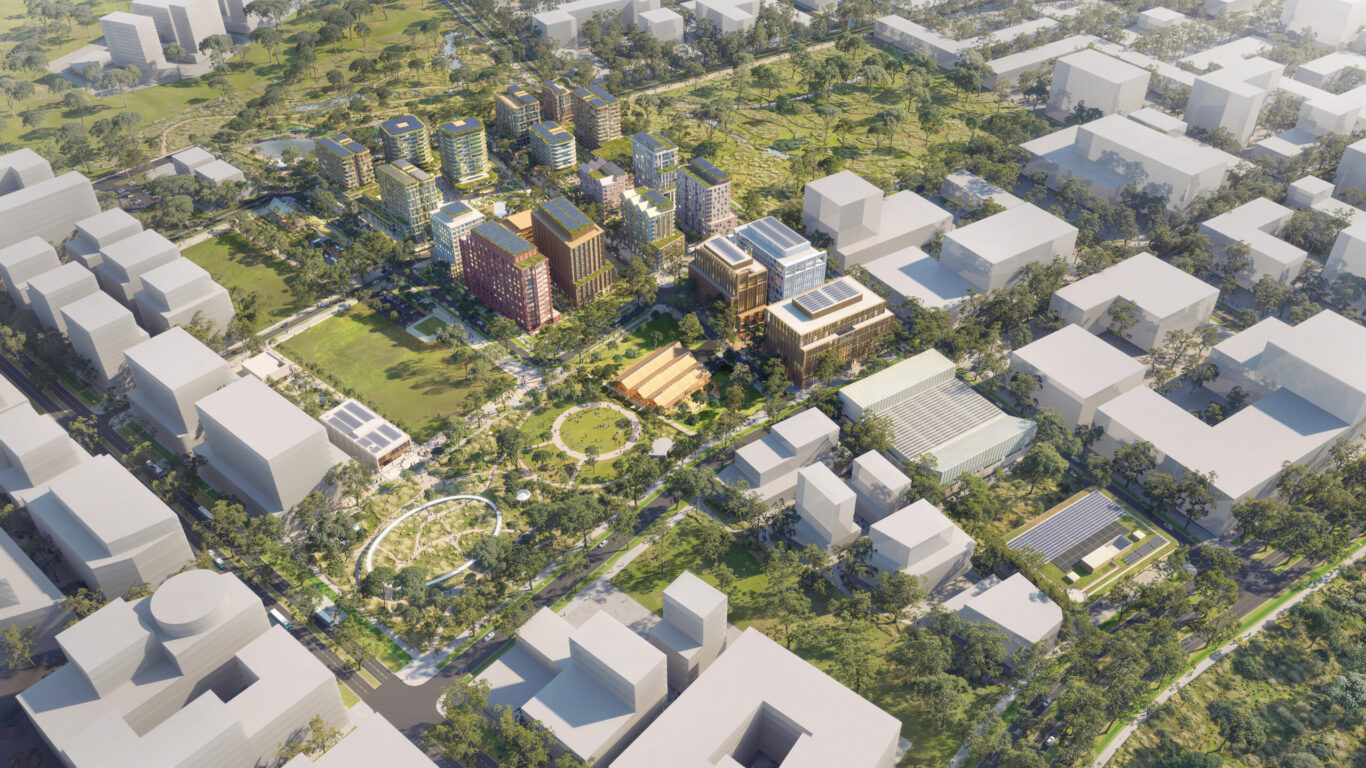
Australia’s first new city in more than 100 years, Bradfield City establishes a climate-resilient, Country-centered urban framework in Western Sydney, integrating housing, education, industry, and public space within a regenerative landscape.

Project Facts
  • Size Site Area: 48,000 square meters
  • Collaborators Hassell
Project Facts
  • Size Site Area: 48,000 square meters
  • Collaborators Hassell

Establishing a new civic heart

Bradfield City is Australia’s first entirely new city in more than a century, marking a transformative investment in Western Sydney’s future. 

Located approximately 50 kilometers west of Sydney’s central business district, the city sits adjacent to the new Western Sydney International (Nancy-Bird Walton) Airport, positioning it as a catalyst for long-term economic growth in one of Australia’s fastest-growing regions. The plan for Bradfield City aligns with government priorities for innovation, equity, and sustainable development.

Bradfield City’s First Land Release is being delivered by Plenary Group, a leading developer of infrastructure and precincts, in partnership with Bradfield Development Authority. 

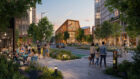
Conceived as the initial civic heart of Bradfield City, the First Land Release spans 5.7 hectares and will deliver more than 1,400 homes—including 10 percent affordable housing—alongside a university campus, commercial offices, hotel, childcare, retail, and extensive public space.

Designed by SOM and Hassell in collaboration with Djinjama and COLA Studio, the First Land Release master plan establishes a framework for inclusive, climate-adaptive urban growth. This includes aligning density with multimodal transportation networks, reinforcing proximity to the metro, the airport, and emerging innovation districts. Concentrating mixed-use development within a walkable framework establishes a compact urban core that supports advanced industries, education, and long-term economic resilience.

Connections to the land

The First Land Release master plan is shaped by deep engagement with First Nations knowledge. The design reinforces a connection to Country, a term used by First Nations peoples to refer to the lands, waters and skies to which they are connected through ancestral ties and family origins. Created in collaboration  with the cultural design and research practice Djinjama, the design places  Country as a foundational principle—integrating land, water, and sky within the built environment.

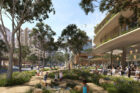
At the core of the precinct is the Green Loop, a linear park that extends the natural systems of Moore Gully into the urban fabric. More than a landscape feature, the Green Loop functions as ecological infrastructure—slowing and cleaning stormwater, reinforcing biodiversity, and mitigating flood risk while honoring the cultural significance of water as the “veins of Country.”

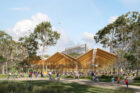
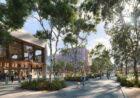
Within this corridor, a timber community pavilion provides a gathering space for all ages. Its woven canopy of interlocking timber reflects the Aboriginal principle of “enoughness,” taking only what is needed. The structure serves as a prototype for low-carbon construction and intergenerational learning, reinforcing the city’s commitment to cultural continuity and environmental stewardship.


To design a new city precinct is both a rare opportunity and a profound responsibility. The First Land Release in Bradfield City is a chance to shape a vision with Country and community, embedding resilience, sustainability, and innovation as a benchmark for future growth in the city.


Advancing climate resilience and circular systems

Resilience is embedded at every scale of the First Land Release. Passive design strategies are reinforced by green roofs, biosolar systems, water-sensitive infrastructure, and low-carbon material selection.

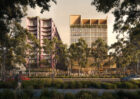
The architectural expression evolves in dialogue with the landscape. Buildings transition from earthy tones near Moore Gully to lighter forms that reference Sky Country along the ridgeline. Materials including terracotta and timber are selected for durability, performance, and reduced embodied carbon.

Deep soil zones and planted corridors mitigate urban heat while strengthening ecological continuity. Integrated water systems manage stormwater onsite, supporting flood resilience and long-term environmental performance.

Together, these strategies establish a scalable framework for net-zero ambition, aligned with Bradfield City’s ambitious sustainability commitments as a benchmark for inclusive, climate-adaptive urban development in Australia.

More Projects

01/