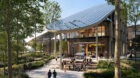
Cement and concrete manufacturing account for at least 8 percent of global carbon dioxide emissions annually, a massive environmental footprint that is expected to grow as global construction accelerates. To address this urgent challenge, SOM partnered with Prometheus Materials to develop a new material, Bio-concrete, a zero-carbon alternative to traditional masonry.
The Chicago Tribune highlighted this joint effort in a feature on the Bio-Block Spiral—an installation of blocks made from Bio-concrete installed in Chicago’s Fulton Market for the fifth Chicago Architecture Biennial. The article features interviews with SOM Design Principal Ryan Culligan and Prometheus Materials CEO Loren Burnett. Discussing the accelerated mineralization process behind the material, Burnett said, “Unlike nature, which might take days, weeks, months, or even years to create a coral reef, we can do it in a matter of hours. We bio-mineralize in commercially viable quantities and time scales.”
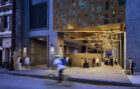
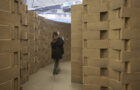
The bio-blocks are engineered using microalgae that undergo a natural bioreactor mineralization process mimicking the creation of coral reefs, turning the cement component into a carbon sink rather than a source of emissions. Culligan explained the immediate benefits of substituting this specific material into standard construction practices, stating, “The installation itself that’s built there saves over a metric ton of carbon compared to an identical structure made with conventional concrete blocks.”
The Bio-Block Spiral marks the first public display of this innovative material, proving that laboratory-tested, algae-based composites can be successfully deployed in small-scale production using familiar construction workflows. Because the manufacturing process relies on ubiquitous resources, common labor practices, and standard molding machines, the technology remains highly scalable for the global market. As the industry grapples with the enormous impact of traditional building materials, the Bio-Block prototype offers a tangible, commercially viable path forward to drastically reduce embodied carbon in future urban development.