With the construction industry accounting for nearly 40 percent of global carbon emissions, scaling the development, testing, and manufacturing of sustainable building materials is essential to addressing a warming world.
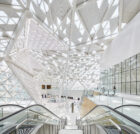
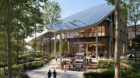
It’s a goal that SOM and The New York Climate Exchange (NYCE)—a nonprofit dedicated to cultivating climate solutions—are working to achieve, starting with the design for the NYCE’s new climate campus on Governors Island.
In a new post for the NYCE blog, SOM Senior Architect Kelsey Lange and NYCE Capital Project Manager Elifmina Mizrahi outline a practical strategy for breaking down barriers to specifying innovative, sustainable building materials.

In planning the new campus, “The Exchange has led hundreds of conversations with industry-standard manufacturers about how they can improve their products, creating a positive impact before construction begins,” the authors state in the article. “Transparency and rigorous specification requirements allow new, sustainable technology to scale.”
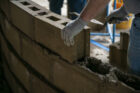
As a case study, Mizrahi and Lange highlighted the project’s use of the ProZERO™ blend—a bio-based cement created by Prometheus Materials in partnership with SOM that replaces 40 percent of conventional cementitious materials.
“Even modest reductions to the carbon footprint of concrete can have an enormous impact when adopted at scale,” Mizrahi and Lange write. “Because ProZERO™ incorporates algae, it has the potential to bring a carbon-absorbing building material to the market.”