This landmark reintroduction of pieces rooted in SOM’s legacy of total design is part of a larger effort to share SOM’s vast archive of bespoke furnishings.
CHICAGO — During Fulton Market Design Days and Chicago Design Week, Skidmore, Owings & Merrill (SOM) and IKONstudio are launching the SOM Collection: a curated selection of historically significant furniture designs created by the firm between the 1950s and early 1990s and now introduced into contemporary production for the first time. The SOM Collection is the inaugural architectural collection presented by IKONstudio, a platform dedicated to identifying, preserving, and reintroducing historically significant furniture designs for contemporary use.
Skidmore, Owings & Merrill may be one of the best-known architecture and design firms in the world, but there is an entire body of work that is largely unknown. For decades—between 1950 and the early 1990s—the firm designed dozens of significant pieces of furniture and objects—each in its own right a part of SOM’s modern, rigorous aesthetic, with a carefully honed sense of ergonomics, material innovation, and environmental responsibility. Originally conceived as integral extensions of SOM’s architecture and interiors, the collection reflects the firm’s longstanding philosophy of “total design,” in which buildings, furnishings, materials, and spatial experience are resolved as a unified whole. Developed for many of the most influential corporate, cultural, and private interiors of the 20th century, these works were bespoke commissions that were designed for specific clients and environments and not intended for commercial release.

Long overshadowed by the commercial prominence of manufacturers such as Herman Miller and Knoll, SOM nonetheless developed one of the most sophisticated bodies of bespoke corporate furniture design in postwar America. It is distinguished by its modernist rigor, an evolving material language of hand-polished stainless-steel frames, glass and stone surfaces, walnut and teak for managerial spaces, and rosewood and exotic burls reserved for executive environments, as well as the extraordinary craftsmanship, customization, and modernist opulence that distinguish the firm’s furniture from contemporaneous commercial offerings.
“From its earliest years, SOM approached design holistically, working fluidly across scales—from cities to buildings to interiors to furnishings,” said Partner Chris Cooper. “These furniture pieces were not conceived in a vacuum. They were part of larger architectural ideas about clarity, proportion, materiality, and experience. Revisiting them allows us to evolve that broader conversation.”
The SOM Collection marks the first time this body of work has been systematically revisited, researched, and adapted for contemporary use, as part of a larger effort by SOM to bring this archive to public awareness. SOM and IKONstudio committed to extensive archival research, prototyping, engineering, material development, and contemporary manufacturing techniques to bring the collection into production while preserving the integrity of the original designs. Each piece is constructed with fidelity to the original design intent, retaining the typologies and materiality that distinguish the works, while evolving production with advanced technology, and sustainable processes.
“These works emerged from a moment when architecture firms were deeply engaged in every aspect of the built environment, down to the scale of the chair,” said Partner Julia Murphy. “We are revealing not only a hidden chapter of SOM’s history, but a set of ideas about permanence, restraint, and design integrity that feel increasingly urgent.”
The inaugural collection centers on two historically significant seating systems: SOM76—originally designed for the IBM headquarters in Armonk, New York—and SOM79—created for legendary fashion designer Halston’s New York atelier.
“SOM’s legacy is exactly the kind of work IKONstudio exists to carry forward,” said IKONstudio Founder David Feldberg. “When design emerges from a coherent architectural vision at this scale, it carries a rigor and an ambition that is inspiring in its deep consideration. Our work is to meet that ambition: to understand how these pieces functioned in their original context and celebrate what they can bring to contemporary interiors, made with the precision and materials available to us today.”

SOM76
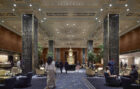
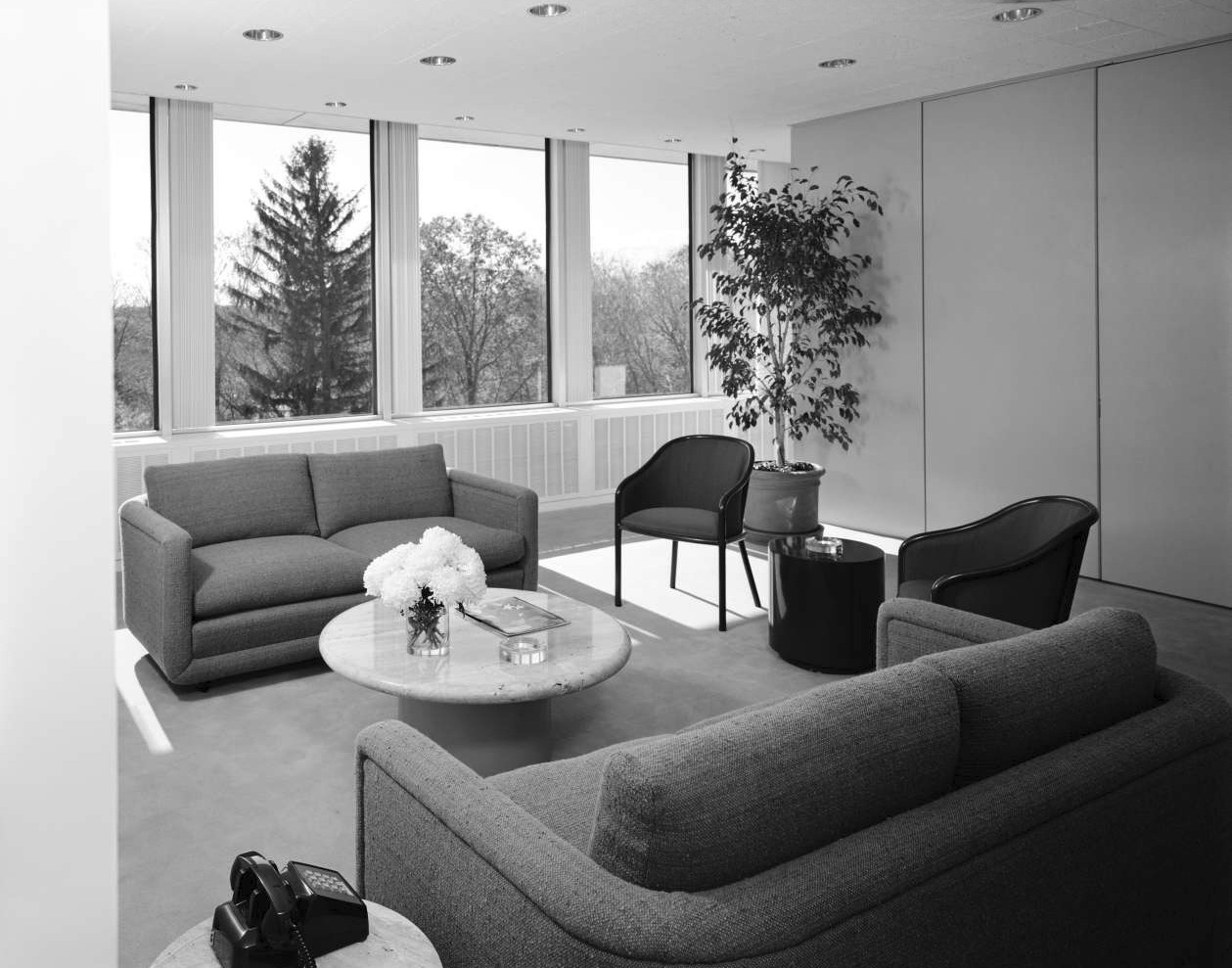
The SOM76 collection was designed for IBM’s World Headquarters in Armonk, New York—a project shaped by the company’s conviction that “good design is good business.” Under the guidance of Eliot Noyes, IBM had embraced modernism as a means of defining its corporate identity, and commissioned SOM to create an environment that expressed clarity, innovation, and cultural seriousness. The SOM76 collection was conceived as part of that whole to furnish the lobby with pieces that extended the architectural language of the building rather than decorating it.
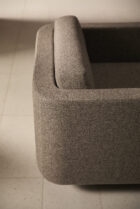
The collection reflects that context directly. Its forms are defined by subtle, tightly tailored curves and continuous lines—comfort achieved through proportion and precision rather than padding or excess. Fully upholstered with softened geometries, the pieces balance rationalism with presence, making them equally suited to corporate, hospitality, and residential environments.
Designed to support shared environments, the SOM76 chair and sofas (both two- and three-seaters are available) provide structured seating for conversation, collaboration, and everyday use. Its scale is deliberate—balanced enough to anchor a room without dominating it, ordered enough to integrate across a range of settings.
The SOM76 Swivel Lounge Chair translates the same design language into individual seating. Its compact, sculpted form retains the collection’s continuous lines and softened geometry, while the swivel base introduces a practical layer of flexibility—allowing movement between positions without breaking the overall sense of order.
Available in a curated range of upholstery options.

SOM79
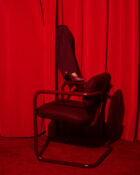
Designed by SOM’s Charles Pfister in 1979 for Halston’s New York atelier, the SOM79 chair sits at the intersection of fashion and architecture.
The Olympic Tower, completed in 1974, is a defining expression of SOM’s modernism—its dark glass façade rising against the stone of St. Patrick’s Cathedral across the street. On the 21st floor, Halston’s studio was a mirrored environment: floor-to-ceiling glass, a palette of red, the Manhattan skyline as backdrop. The SOM79 chair was designed for that context.
Its cantilevered steel frame delivers comfort through structure rather than padding—a curvilinear form that holds tension between hard and soft, industrial and emotional. The architectural clarity of the piece allows it to move between settings: office, residence, cultural institution.
The SOM79 table is a new addition to the product family and continues the same design language. A continuous chrome frame supports a glass surface that keeps the structure visible and the overall form light. It works equally as a dining table, a work surface, or a gathering point.
Chair: Available in a sustainable polished chrome finish with a curated palette of LUUM leather and fabrics; Table: Available in a sustainable polished chrome finish with clear, smoked, or bronze glass top.

“Our legacy in custom furniture design continues to inform a forward-looking approach grounded in exceptional materials and enduring utility,” said Partner Olin McKenzie. “These designs were created to last—to be both culturally resonant and materially durable. Bringing them back into the collective consciousness reinforces the continuing relevance of that philosophy.”
Rather than treating the archive as an exercise in nostalgia, the collaboration approached the collection as a living body of design intelligence. Each piece has been carefully studied and refined to meet contemporary standards of ergonomics, sustainability, durability, and manufacturing precision while remaining faithful to the original design intent.
The process included subtle recalibrations to seating proportions and comfort, updated material specifications aligned with present-day environmental standards, and refined fabrication techniques that preserve the architectural integrity and visual discipline of the original works.
The launch of the SOM Collection follows a broader expansion of SOM’s product and industrial design practice in recent years. Recent collaborations include Tetras, a modular lighting system developed with Artemide and presented during Salone del Mobile and FuoriSalone in Milan; Dyad, a marble mosaic collection created with AKDO; and Nebula, a public lighting fixture developed with Neri and installed at the Milano Cortina Olympic Village, among other urban settings.
As part of SOM’s ongoing collaboration with Form Portfolios, the firm is working with the furniture maker Haworth on a late-2026 launch of a collection of more archival furniture. Together, these projects continue SOM’s multidisciplinary design tradition, which extends architectural thinking into objects, systems, and environments at every scale.