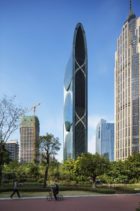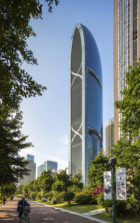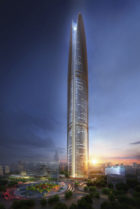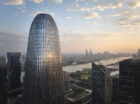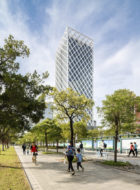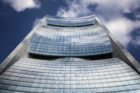
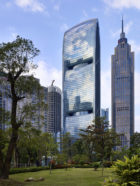
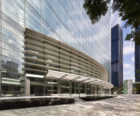
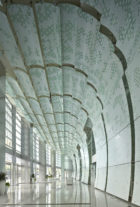
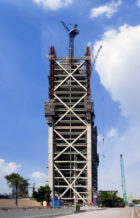
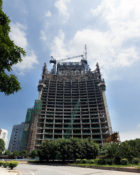
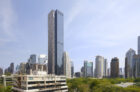
The 71-story, 2.3 million sf Pearl River Tower is expected to be the world’s most energy-efficient supertall office tower upon completion, and a milestone along the way to energy independence.
In 2005, SOM presented plans for a new headquarters tower in Guangzhou that would incorporate the latest sustainable technology and engineering know-how in an attempt to create the world’s most energy efficient high-rise structure – a tower that would significantly reduce its dependency on the city’s infrastructure. The design of the ‘zero-energy’ concept Pearl River Tower reflects the principle of humankind in harmony with the environment. Pearl River’s sleek, aerodynamic form was developed through a careful understanding of solar and wind patterns around the site. The building optimizes the solar path and utilizes the sun to its advantage. The building also minimizes the interference of wind forces and uses them to relieve the structural burdens imposed by high-wind pressures.
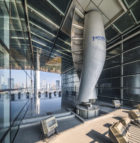
Pearl River’s sculpted body directs wind to a pair of openings at its mechanical floors. Traveling winds push turbines which generate energy for the building’s heating, ventilation and air conditioning systems. Energy consumption is reduced by maximizing natural day-lighting, reducing solar gain in air conditioned spaces, retaining rainwater for gray-water usage, and by utilizing solar gain for attaining the building’s hot water supply. The office tower is chilled by a combination of displacement ventilation, radiant panel cooling and chilled beams and incorporates optimized air and water delivery systems and optimized building management systems. Solar collectors integrated into the façades transform the sun’s energy to usable AC current.
Pearl River Innovations
Pearl River Tower weaves together a number of highly innovative technologies, which work together to significantly reduce the amount of energy required to operate the building’s infrastructure and ensure the highest levels of human comfort and indoor air quality.
Wind Turbines
The most innovative of Pearl River’s elements, the two vertical axes integrated wind turbines harness
prevailing winds from the south and the north with minor efficiency loss. The tower’s curvilinear form further enhances performance by helping to funnel air through turbine inlets in the façade. Wind studies have predicted the turbines will speed up the wind’s velocity two-and-a-half times. The power is then converted to energy and used to dehumidify the building.
High-Performance Building Envelope
The design incorporates a dynamic high-performance building envelope. The façade system is oriented to optimize the use of daylight while controlling solar loads:
- An internally ventilated high-performance double skin façade with automated blinds is used for the northern and southern orientation.
- A triple-glazed façade with external shades and automated blinds within the glazing cavity is used for the east and west elevations.
- A photovoltaic system is integrated into the building’s external shading system and glass outer skin.
In addition, exhaust air is routed through the cavity of the double-layer curtain-wall, heating up as it travels upward to the mechanical floor. The ventilation and dehumidification system uses this hot, dry air from the double-wall as an energy source.
Radiant Cooling/Chilled Beams with
Displacement Ventilation
The chilled beams and radiant cooling system delivers sensible cooling directly to the space by incorporating chilled water piping that cools the room by natural convection and radiation heat transfer. It is used in combination with direct outdoor air systems (DOAC) to allow for exceptional environmental comfort while addressing ventilation issues.