Story

Projects to Watch in 2026

A preview of the year ahead in architecture, engineering, interiors, and urban design

California’s largest art museum will open a long-awaited expansion, a historic building in Melbourne begins a new life, and a cutting-edge laboratory will bolster New York City’s healthcare system. These are a few of the projects we’re looking forward to celebrating in 2026—a year that marks our firm’s 90th anniversary. The projects included here reflect our work in cities where SOM has had a presence for decades, and also in regions where we’ve recently established local studios to serve growing markets.

New and improved transportation infrastructure—from an airport in the Democratic Republic of the Congo to the renovation of a Chicago “L” station—will enhance connections to and within cities across the world. Two large developments designed to host global events—the Winter Olympics athletes’ village in Milan and the APEC forum in Vietnam—will serve their respective cities long after the conference and games have ended. Together, this selection of 13 projects offers a snapshot of our design practice, focused on making a positive impact for people and the planet.
A sculptural mosque takes shape on Palm Jebel Ali

Palm Jebel Ali Friday Mosque
Dubai, United Arab Emirates

Bloom Images © SOM | Nakheel

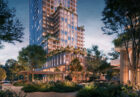
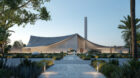
At Palm Jebel Ali, an artificial archipelago off the coast of Dubai, SOM is designing the Friday Mosque that will serve as the residential development’s spiritual and communal center. Set to break ground in 2026, the project reinterprets Islamic and Emirati architectural traditions through a series of contemporary, sculptural forms.

The design began with a single question: how might the sahn, the traditional Islamic courtyard, be reimagined for a coastal environment? SOM’s response is a shaded, open-air court defined by a cascading chainmail canopy that filters daylight, captures sea breezes, and creates a calm, contemplative sanctuary. Inspired by narratives from the Quran, this canopy becomes the mosque’s unifying architectural gesture.

The mosque’s exterior will be built in white concrete and limestone, materials selected for their durability in a marine climate and their ability to weather gracefully over time. Designed to welcome up to 1,000 worshippers, the building’s form, light, and materiality come together to establish a serene new landmark for Palm Jebel Ali.


Vietnam’s largest island prepares to host a major conference, and many more beyond

Phu Quoc APEC Vision Plan
Phu Quoc, Vietnam

© SOM | INPLACE

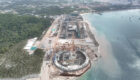
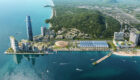
One of the world’s largest economic forums, the Asia-Pacific Economic Cooperation (APEC), is coming to Phu Quoc, Vietnam, in 2027, and SOM is designing and planning its waterfront venue. Planned as a new civic and cultural district, it will host the summit and serve the island long after the event concludes. In addition to the master plan, SOM is designing and engineering some of the largest buildings in the development, including a conference and exhibition center, an arena, and a tower with hospitality, retail, and expansive public spaces, close to Phu Quoc’s famed resorts and white sand beaches.

The complex will accommodate nearly 15,000 attendees from the 21 APEC member economies. SOM’s plan for the district centers on a signature outdoor venue that can host performances, exhibitions, and community events. A central boulevard, surrounded by lush landscapes and a new park, will connect with more than two kilometers of promenades and plazas. Combined with major upgrades to transit infrastructure, the development supports the island’s emerging role as a center for business, diplomacy, and international tourism.

Construction progress as of December 2025. Courtesy Sun Group


A new landmark for K-12 public education opens in the Bronx

Success Academy
Bronx, New York

© SOM | Norviska

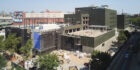
SOM’s design for Success Academy’s first ground-up, purpose-built campus manifests the charter school’s ambitious vision for academic excellence. Embodying Success Academy’s unique approach to K-12 education—a unified 13-year learning journey designed backward from college preparedness—the South Bronx campus shows what is possible when innovative design is harnessed to advance a bold educational mission.

Opening at the start of the 2026-27 academic year, the campus unites 2,400 elementary, middle, and high school students into a seamless learning environment that supports world-class STEM, humanities, arts, and athletics. Clad in luminous, green-glazed brick and shaped by cascading terraces and play spaces, the building is open and interconnected. Its defining feature—the “scholar spine”—runs the full length of every floor, creating an active civic corridor that fosters collaboration and visual continuity across all grade levels. With the College Access and Preparation office prominently situated along the main path, every scholar encounters their future destination from day one.

Just 20 minutes from Midtown Manhattan, the campus is poised to become a destination for educators and civic leaders seeking to understand how thoughtful design can energize and elevate the future of American schooling.

Construction progress as of August 2025. Lucas Blair Simpson © SOM

A cutting-edge laboratory strengthens New York City’s public health system

New York City Public Health Laboratory
New York, New York

New York Public Health Lab Rendering
© SOM | ATCHAIN

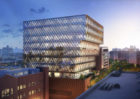
Under the direction of the New York City Department of Health and Mental Hygiene, the Public Health Laboratory (PHL) has been at the forefront of disease response and investigation in New York for more than a century. In 2026, the doors will open at the PHL’s new, 240,000-square-foot facility: a state-of-the-art testing center for routine screening and harmful toxins and diseases.

Conceived in two parts, the building is both a secure laboratory and a community resource in Harlem, a long-underserved neighborhood. The building meets the ground with a three-story masonry podium, offering quick clinical testing for visitors and a training laboratory for students to learn about careers in healthcare and science. Above, the laboratory floors rise within a glass cube stitched by a structural metal diagrid—giving the building its signature aesthetic and passive solar shading. The floor plates get progressively larger as the building rises, and with the structure pushed to the perimeter, the laboratories inside will remain customizable as science and technology evolve.


Athletes, then students, will take up residence at Milan’s Olympic Village

Milano Cortina Olympic Village
Milan, Italy

Dave Burk © SOM
© SOM | Pixelflakes

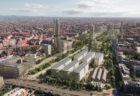
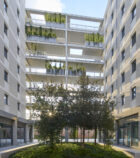
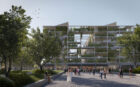
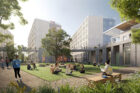
All eyes are on Milan as the Italian city prepares to host the February 2026 Winter Olympics. Competitors from around the world will take up residence in the new Athletes Village, built as part of a larger urban regeneration project on the former Porta Romana rail yard. Completed in just 30 months and delivered 30 days ahead of schedule, the project sets a new standard for sustainable Olympic developments and holds an important legacy for the city of Milan.

Designed to become an integral part of Milan’s urban fabric, the Olympic Village comprises six new residential buildings and two refurbished historic structures, connected by public spaces. Immediately following the Games, the buildings will be converted to their permanent use as affordable student housing—the largest such development in Italy—addressing a significant shortage of student beds in Milan.

The conversion will take place in just four months, allowing students to move in for the 2026-27 academic year. The plaza at the center of the development will become a vibrant neighborhood square, with shops, bars, restaurants, and cafes at street level, as well as outdoor spaces for community events.

Dave Burk © SOM
© SOM | Pixelflakes

A landmark residential development rises in Chicago

400 Lake Shore
Chicago, Illinois

Tomorrow AB © SOM | Related Midwest

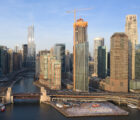
Sited at the confluence of Lake Michigan and the Chicago River, 400 Lake Shore is reshaping the Chicago skyline, bringing two, nearly 900-foot-tall towers to the city’s eastern edge. Combined, the buildings will add more than 1,700 residential units to downtown Chicago, with pedestrian connections to the Riverwalk and the future DuSable Park.

The towers evoke a cascading waterfall, stepping outward in a series of terraces facing the lake. This distinctive tapering form will be visible on the skyline when the first of the towers tops out in 2026.

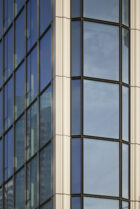
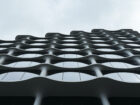
As construction nears completion over the following year, the cladding will reveal a feature that nods to the city’s architectural history. The facades of 400 Lake Shore are designed as shallow bays of floor-to-ceiling glass—a reinterpretation of the classic Chicago bay window—with metal detailing that evokes the rippling surface of Lake Michigan. It is a unitized curtain wall system, which enables repetition in the fabrication process that will speed the project’s construction.

Construction progress as of December 2025. Dave Burk © SOM
Dave Burk © SOM

Work begins on a reimagined transit hub

State/Lake Station
Chicago, Illinois

© CDOT
© CDOT

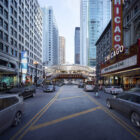
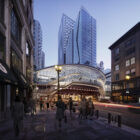
The State/Lake Chicago Transit Authority (CTA) station, a key junction in the Chicago Loop, has provided access to downtown shopping, entertainment, and business for more than a century. With ridership increasing and a need for improved accessibility, the Chicago Department of Transportation and CTA commissioned SOM to design a dramatic transformation of the station, with work scheduled to begin in early 2026.

The improvements begin at street level, where new elevators and escalators will provide a safe and equitable way for passengers with strollers, baggage, and mobility challenges to reach the elevated platforms. The platforms themselves will be widened and elongated—increasing the number of turnstiles and overall capacity—and a new, glass-enclosed bridge will serve commuters transferring between trains. Overhead, a fritted glass canopy will provide relief from the rain, snow, wind, and sun, while maintaining strong visual connections to the cityscape.


A new air terminal positions the DRC for international and domestic growth

N’Djili International Airport Terminal
Kinshasa, Democratic Republic of the Congo (DRC)

© SOM

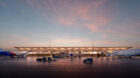
In July, SOM unveiled the design for the development and expansion of N’Djili International Airport in Kinshasa, the Democratic Republic of the Congo’s primary aviation gateway. Site preparation is already underway, and construction will begin next year on this transformative project that aims to position Kinshasa as a globally connected city.

SOM’s masterplan includes a full replacement of existing terminal operations, along with new infrastructure and facilities to support both international and domestic growth. Modular and scalable, the new terminal will accommodate up to 5 million passengers annually by 2037, with long-term capacity expandable to 9.1 million by 2050.

SOM’s design is inspired by the country’s natural environment and cultural heritage. A rich, mineral-inspired material palette—evoking native earths and stone—grounds the building in its setting. An expansive canopy, inspired by traditional Congolese basketry, creates a distinctive architectural identity for a modern transportation gateway for the DRC and Central Africa.


New galleries open in a monumental addition to Los Angeles’s cultural scene

David Geffen Galleries, Los Angeles County Museum of Art (LACMA)
Los Angeles, California

James Michael Juarez © SOM

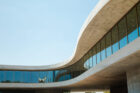
In April, the David Geffen Galleries will open to the public as the new home for the Los Angeles County Museum of Art’s permanent collection. Designed by architect Peter Zumthor in collaboration with SOM as both architect of record and structural engineer, the new building is a sweeping, 900-foot-long structure that extends across the existing LACMA campus and floats over Wilshire Boulevard. It replaces four aging buildings with a single, open gallery floor, inviting visitors to experience a continuous, non-hierarchical display of art elevated 30 feet in the air.

Architectural concrete is both the primary structure and the finished surface, giving the building a sculptural presence and quietly refined galleries inside. Seven glass-enclosed pavilions at street level support the exhibition floor and house visitor services, retail, education spaces, and a theater. Outside, a new landscaped plaza and sculptural garden connect the new building with the public realm.

SOM engineered a highly advanced seismic resilience system to protect the building, its users, and the art inside in the event of an earthquake. The structure sits atop 40 state-of-the-art base isolators, which allow the building to shift up to five feet in any direction during a seismic event.


UC Santa Barbara expands student housing

University of California, Santa Barbara – San Benito and East Campus Student Housing
Santa Barbara, California

Bloom Images © SOM | Mithun

With plans to increase student enrollment, the University of California, Santa Barbara is working with SOM and Mithun to develop the largest capital projects in its history: two multi-building residential developments that, together, will add housing for more than 3,500 students. The projects—San Benito Student Housing and East Campus Student Housing—are slated to reach significant milestones this summer.

The East Campus development, consisting of four new buildings and a renovation of the Ortega Dining Commons, is set to break ground, while the seven-building San Benito project will top out at the campus’ northwest corner. The San Benito buildings will accommodate about 2,200 students, along with a market, lounges, and additional amenities supporting student life. The buildings are oriented to channel ocean breezeways across the six-acre site, and at its center, a pedestrian promenade will connect the buildings and a series of garden courtyards, framing panoramic views of the Santa Ynez Mountains. SOM’s Sustainable Engineering Studio conducted a comprehensive lifecycle and whole life carbon assessment for both projects—reducing embodied carbon by 21 percent below the ASHRAE 2010 baseline, and decreasing energy use by 42 percent.


A historic Melbourne building becomes a new destination—and a studio for SOM

189 Toorak Road
Melbourne, Australia

© SOM | Norviska

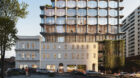
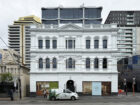
Since 1887, the South Yarra Coffee Palace—one of the many ornate hotels that emerged during Australia’s temperance movement—has stood on Toorak Road, a prominent retail corridor in Melbourne. A new chapter in the building’s life is just beginning: SOM is revitalizing the historic structure with 2,500 square meters of retail and wellness spaces, and a new, 11-story addition that introduces contemporary workspaces.

The reimagined building sensitively integrates old and new. The 19th-century facade has been carefully restored, and the addition above steps back to recede from view, giving the Victorian landmark center stage. The addition rises in a series of cascading terraces that offer outdoor space at multiple levels, and with floor-to-ceiling glass within a lattice structure, each space will be open in plan and receive ample sunlight. It’s a perfect setting for a creative studio—and in March 2026, SOM will be moving its Melbourne office to the seventh floor. 

Construction progress as of October 2025. Jarrad Morgan © SOM
Jarrad Morgan © SOM

Work begins on a mixed-use development in Uptown Dallas

2500 Cedar Springs
Dallas, Texas

Courtesy Proper Hospitality

SOM recently opened an office in Austin to lead a growing roster of current and ongoing projects in Texas, including the expansion of Austin-Bergstrom International Airport. In Dallas, another major project is moving forward: 2500 Cedar Springs, an expansive mixed-use development that will add offices, residences, and hospitality to this growing Uptown district. The neighborhood is known for its pedestrian-friendly streets, and the four-acre development will enhance that connectivity with a trio of towers rising above retail and green space. Native plantings will shade the pedestrian plaza, contributing to a verdant urban development with a strong sense of place.


Ferries will serve a new waterfront community in Zhuhai, China

Jiuzhou Bay
Zhuhai, Guangdong, China

Construction progress as of December 2025. Michael Leung © SOM

The Greater Bay Area—a collection of nine coastal cities in China and the administrative regions of Macau and Hong Kong—is one of the world’s leading hubs for technological innovation and industry. This economic growth is spurring large-scale development, and the first phase of a new, mixed-use neighborhood in Zhuhai is anticipated to complete in 2026.

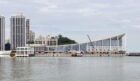
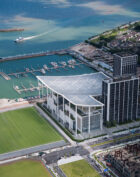
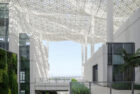
Located along the coast, Jiuzhou Bay will establish Zhuhai’s gateway to the Pearl River Delta, with a 1.8-million-square-foot port offering connections to the Greater Bay Area by road, rail, and sea. A ferry terminal in this transit center will open in the summer, when construction concludes on five modular canopies shading the entire port. Retail spaces beneath those canopies will open as well, along with residential buildings in the streets beyond.

Construction progress as of October 2025. Oliver Deng © CATOPTOGRAM
Oliver Deng © CATOPTOGRAM