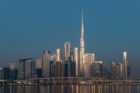

Senior Associate Principal and Project Engineer Brad Young recently joined partners from Related Midwest and Bowa Construction to discuss the structural development of 400 Lake Shore with Engineering News-Record (ENR). The article, “Chicago Towers Will Alter Skyline And Mitigate Wind Impacts,” explores the technical rigor and collaborative effort required to construct the 900-foot twin towers at the confluence of the Chicago River and Lake Michigan—a site uniquely challenged by powerful wind currents.
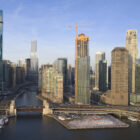
The piece highlights the critical coordination between the design and construction teams to bring this ambitious development to life. Alongside Young, Bowa Construction President and CEO Nosa C. Ehimwenman and Related Midwest Executive Vice President Don Biernacki and Senior Superintendent Rich Goodwin detailed the complex delivery of the project. Their discussions centered on the installation of the tower’s robust beltwall and outrigger systems. The implementation of these proven structural technologies safely stiffens the tower and stabilizes the building against powerful lakefront gusts, maximizing usable floor space for residents without the need for traditional tuned mass dampers.

According to Young, SOM’s architects and structural engineering teams leveraged advanced wind tunnel testing to evaluate and refine the towers’ forms, resolving a pronounced “wind cavern effect” across the site. “As architects and engineers, we know that architectural form is the single most influential factor in wind performance,” he said. “We focused on the upper half of the tower where wind forces are strongest. That’s where the setbacks occur, and they ended up being a win-win. They create terraces and reduce wind effects.”
By strategically stepping the towers back at higher elevations, the design effectively breaks up strong wind currents and reduces pressure on the exterior facade. Ultimately, this synthesis of architecture and engineering demonstrates how tall buildings can address environmental challenges through integrated design, resulting in a refined structural solution worthy of this prominent site along Chicago’s waterfront.