One World Trade Center
New York, New York
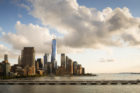
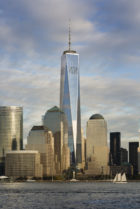
1 World Trade Center is the first office tower to rise on the actual World Trade Center site. A memorable architectural landmark for New York City and America, the Tower will soar to 1,776 feet in the sky and serve as an inspirational and enduring beacon in the New York City skyline.
Project Facts
Completion Year: 2013
Site Area: 75,000 ft2
Project Area: 3,500,000 ft2
Building Height: 1,776 ft
Number of Stories: 104
Curtain Wall & Base
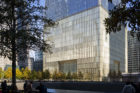
For the curtain wall, architects worked with industry experts to develop glass of a new monumental scale that is capable of withstanding the wind pressure of a super-tall building as well as stringent security requirements. The 5’ by 13’4” insulated glass panels span the full 13’-4” floor-to-floor height with no intermediate mullion – a first in skyscraper construction. These glass panels allow for maximum daylighting and impart monumental scale to the project. The eight corners of the building are clad with stainless steel panels, with each panel spanning the full height of a floor.
The tower rises from a podium wall base whose square plan – 200 feet by 200 feet – is the same size as the footprints of the original Twin Towers. The podium wall base is 186 feet tall and its cladding is being designed to create a dynamic, shimmering surface that animates the experience of the building at ground level.
Life & Fire Safety
The building incorporates advanced life-safety systems that exceed the requirements of the New York City Building Code and will lead the way in developing new high-rise building standards. In addition to structural redundancy and cementitious fireproofing that is dense and highly adhesive, the building includes biological and chemical filters in the air supply system. To allow for optimum egress and firefighting capacity, extra-wide pressurized stairs, multiple backup systems for emergency lighting, and concrete protection for all sprinklers and emergency risers are being provided, in addition to interconnected redundant exits, additional stair exit locations at all adjacent streets, and direct exits to the street from tower stairs. All of the building’s life-safety systems – egress stairs, communication antennae, exhaust and ventilation shafts, electrical risers, standpipes, and elevators – are encased in a three-foot-thick concrete core.
This building is being designed to facilitate emergency response with enhanced communication systems, together with a dedicated stair for use by firefighters. These are used in conjunction with enhanced elevators, housed in a protected central building core, that serve every floor of the building. In addition, protected tenant collection points are located on each floor.
To satisfy security concerns, the building’s setback distance from West Street (Route 9a) was increased from 25 feet to an average of 90 feet in June 2005.
Location & Program
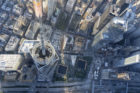
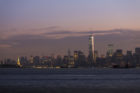
From its site adjacent to the World Trade Center Memorial, One WTC rises 1776 feet to mark its important place in the New York City skyline. The building is located on the northwest corner of the 16-acre World Trade Center site, on land claimed from the Hudson River over two centuries of development in Manhattan. The site, several blocks east of the river and in the heart of the financial district, will ultimately house more than 10 million square feet of commercial development in five towers.
One WTC is a publicly owned commercial building with 2.6 million square feet of office space, an observation deck, a world-class restaurant and broadcast and antenna facilities. The below-grade concourses include approximately 55,000 square feet of retail space and connect to an extensive transportation and retail network that includes 13 subway lines, PATH commuter trains to New Jersey, and possible future train connections to Long Island and the airports
The program is organized as follows: Rising from the plaza level, a 50-foot-high public lobby is topped by a series of mechanical floors; together these form the186-foot-high building base. Seventy-one office floors (floors 20 – 90) rise above the base to an elevation of 1131 feet. Mechanical floors, a restaurant and a two-level observation deck culminate in a metal and glass parapet, whose cap marks 1362 feet and 1368 feet – the two heights of the original Twin Towers. A communications platform ring rises above the parapet and a 408 -foot, cable-stayed antenna, designed in collaboration with artist Kenneth Snelson and structural engineer Hans Schober of Schlaich Bergermann and Partner, crowns the project.
Plaza & Lobbies
An architectural conception allows the building to flow out into the plazas to create areas for people to gather, sit, relax and reflect. Ribbons of stainless steel cascade down from behind the prismatic glass façade of the base to form a series of step terraces that integrate the horizontal surfaces of the plaza into the vertical surface of the building. At night, the ribbons are illuminated from within to create continuous strips of light. The terraces, made of textured stainless steel, are shaded by a ring of trees that further humanizes the scale of the space. The plaza is richly textured with sets of small granite cobblestones.
Generous open spaces are filled with trees, water, and places of respite for the tenants and the estimated 3 million annual visitors. These areas connect the tower with the adjacent neighborhoods and allow views and access into the memorial. Glass walls at the plaza edges provide protection from the wind. While incorporating enhanced security measures, the building remains open and accessible.
Entrances on all four sides of the building, each 60 feet high and ranging in width from 30 feet on the east and west sides to 50 feet on the north side and 70 feet on the south, activate the building at street level. The entrances are defined by glass canopies and large clear glass cable-stayed walls framed by metal portals.
The west portal provides entrance to both the lobby of the observation deck on the concourse level and the transportation systems.
The east portal provides access for office tenants and restaurant patrons who will ascend to the top of the building.
The wider north and south entrances, which provide access for commercial office tenants, are marked by an array of dichroic glass panels. These panels, composed of multiple layers of clear, etched and dichroic glass, draw on the spectral qualities of light to create vibrant color patterns across the surfaces of the lobby. The design draws on the results of a year-long research project into the optical effects of dichroic glass in transmission and reflection.
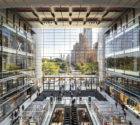
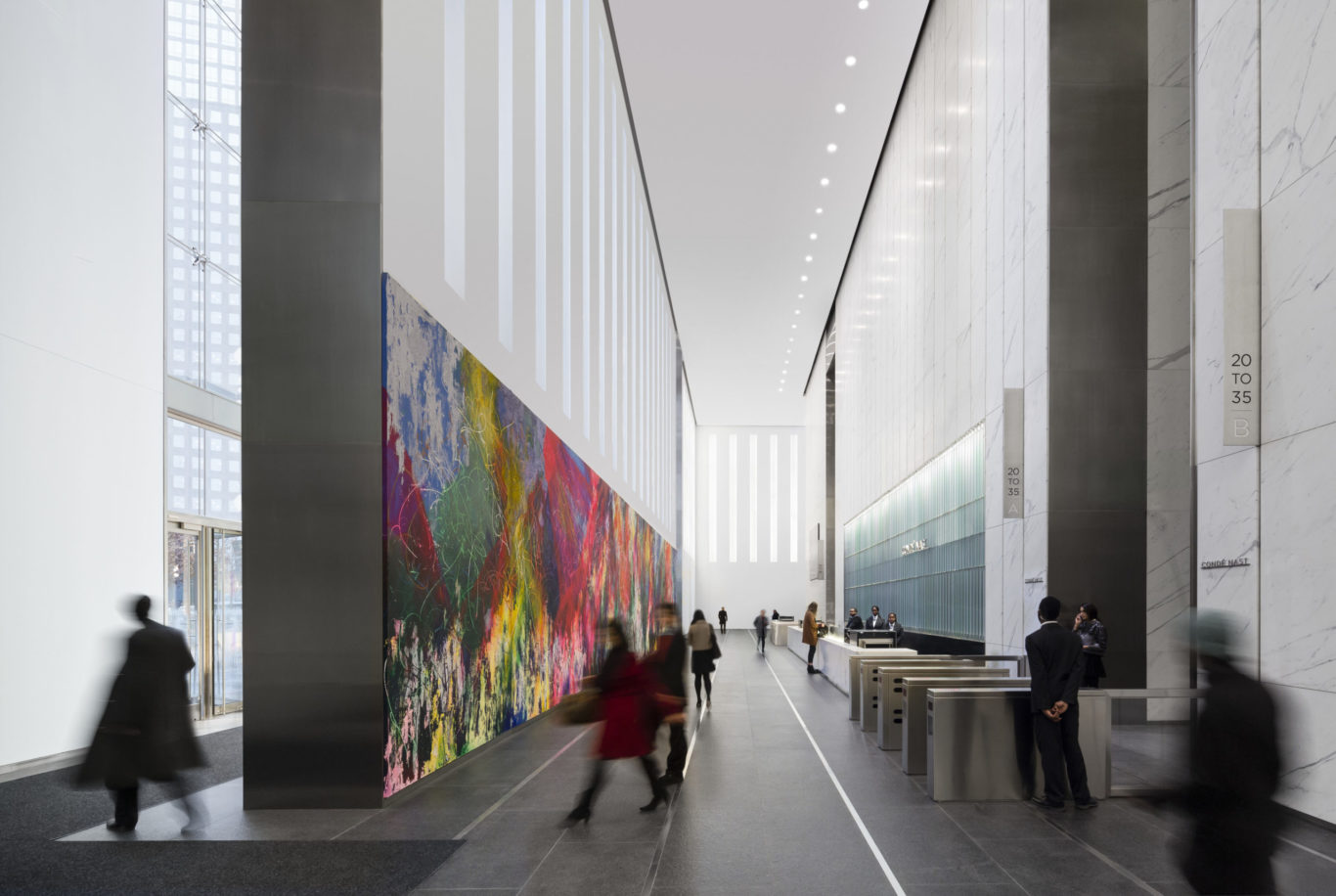
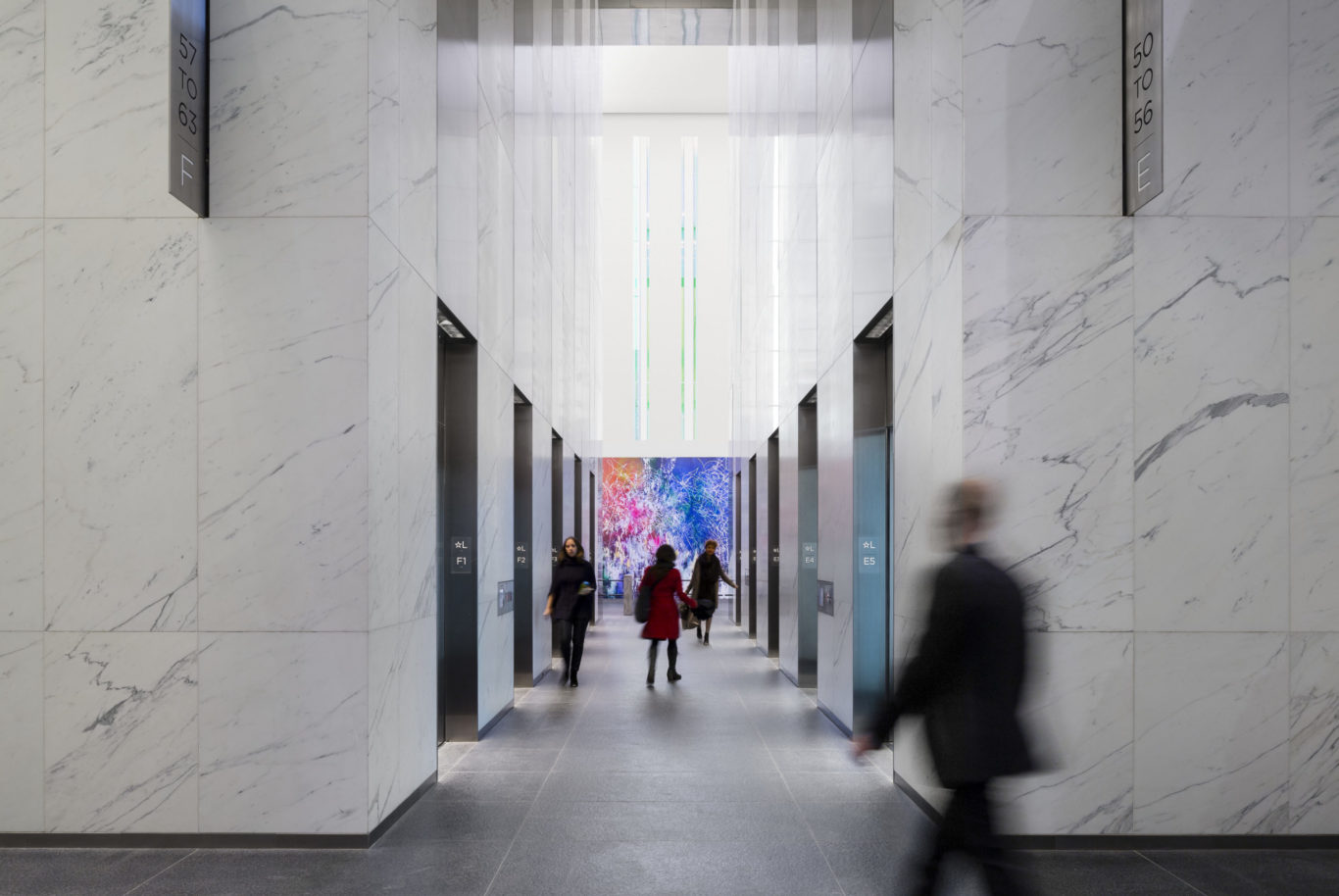
The grand lobby encircles the central core and is filled with natural light that enters the space through the east and west entrances as well as through apertures in the north and south walls. Carrara marble will be used to clad the lobby walls.
The tower rises from a podium wall base whose square plan – 200 feet by 200 feet – is the same size as the footprints of the original Twin Towers. The podium wall base is 186 feet tall and consists of vertical laminated glass fins and horizontal stainless steel slats. The more than 4000 glass fins, each measuring 13 feet 4 inches by two feet, are positioned at varying angles in a regular pattern over the height of the podium. This pattern both accommodates ventilation for the mechanical levels behind the podium wall, and in combination with a reflective coating refracts and transmits light to create a dynamic, shimmering glass surface.
Project Description
As the first office tower to rise on the World Trade Center site, One World Trade Center recaptures the New York skyline, reasserts downtown Manhattan’s preeminence as a business center and establishes a new civic icon for the country. It is a memorable architectural landmark for the city and the nation – a building whose simplicity and clarity of form will remain fresh and timeless. Extending the long tradition of American ingenuity in high-rise construction, the design solution is an innovative mix of architecture, structure, urban design, safety and sustainability.
One WTC is a bold icon in the sky that acknowledges the adjacent memorial. While the memorial, carved out of the earth, speaks of the past and of remembrance, One WTC speaks about the future and hope as it rises into the sky in a faceted, crystalline form filled with, and reflecting, light. This tower evokes the slender, tapering triangular forms of great New York City icons such as the Chrysler Building and Empire State Building and replaces almost one quarter of the office space lost on September 11, 2001. (Overall, downtown lost approximately 11 million square feet of office space on September 11th, with ten million square feet lost at the World Trade Center proper.)
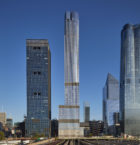
As the tower rises from this cubic base, its square edges are chamfered back, transforming the square into eight tall isosceles triangles in elevation. At its middle, the tower forms a perfect octagon in plan and then culminates in a glass parapet whose plan is a 150’ by 150’ square, rotated 45 degrees from the base. Its overall effect is that of a crystalline form that captures an ever-evolving display of refracted light: as the sun moves through the sky or we move around the tower, the surfaces appear like a kaleidoscope, and will change throughout the day as light and weather conditions change.
Antenna
The antenna consists of two major components: a 408 -foot mast and a communications platform ring. The mast is a hybrid structure, consisting of a steel tower supporting the antenna and a special protective enclosure, called a radome, that is transparent to radio waves. The steel tower has eight sections stacked vertically and decreasing in width, while the radome enclosure is formed of a modular, fiberglass composite sandwich panel system arranged as octagonal antiprism modules. This folded plate enclosure structure is the first of its kind to be used in antenna construction. The panels work not only as simple plates in bending, as is the case for most cladding, but the folded plate structure exploits the spatial geometry and stiffens the ensemble to resist wind loading. The geometry of the radome shell is based on a repeating modular system that allows for easy replacement and erection and also creates a protected maintenance area that is unique in the antenna industry. Large helical channels, called strakes, are built into the geometry of the radome and wrap around the antenna to direct wind up and away from the structure.
To add more support against wind, eight RF (radio-frequency) transparent Kevlar guy cables are connected from the mast back to the ring. Window-washing equipment is incorporated into the antenna ring structure. Because of its circular shape, this design makes it possible to service the building with only three maintenance units.
When lit at night, the mast’s surface will appear as a faceted surface, while a beacon at the top will send out a horizontal light beam that can be seen from miles away.
Sustainable Design
One WTC uses new technologies to maximize efficiency, minimize waste and pollution, and reduce the impact of its development. The building’s design incorporates strategies for water and energy conservation that go well beyond the requirements established by the World Trade Center Sustainable Design Guidelines.
One WTC will use 30 percent less water than the New York City Building Code allows for this type of building. A system for collecting 100 percent of the rain water that falls within the site boundaries is being put in place; this reclaimed water will be used for landscape irrigation and to fill the plaza pool. A 1.2-megawatt, next-generation fuel-cell plant – one of the largest commercial fuel-cell installations in the country – is integrated into the building’s mechanical and electrical systems and contributes to energy use that is 20 percent less than proposed under the city building code. One WTC uses a new form of high-performance, low-E glass coating technology to maximize “daylighting” and minimize heat gain. Maximizing the amount of natural light used in the building contributes to energy savings by reducing the need for artificial lighting.


Back to Top