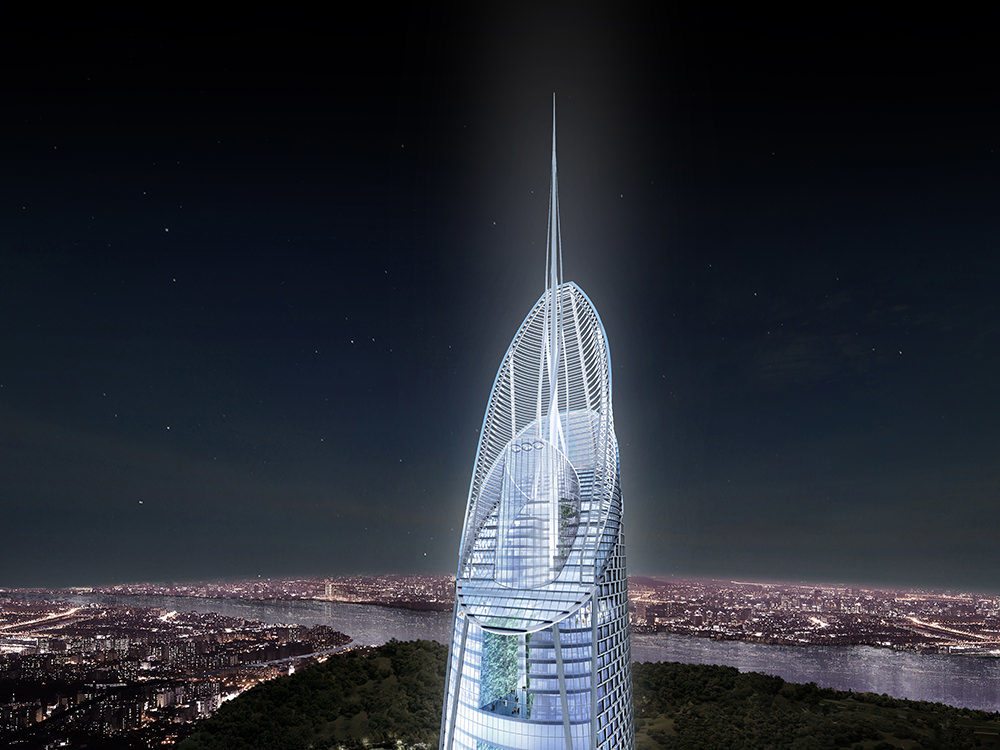
Developed using principles of performance-driven, fully-integrated, sustainable and regenerative design, the Digital Media City (DMC) Landmark Tower will become one of the most significant sustainable structures on the planet. The marriage of ecologically-sound strategies and the development of new technology will make possible this iconic, architecturally significant, fully-integrated, environmentally responsive, high-performance structure that is capable of achieving a new benchmark in sustainable thinking.
The DMC Landmark Tower will operate sustainably, incorporating natural ventilation, enhanced daylighting and generated electricity. These features are achieved by harnessing natural forces occurring within and around the building. The sun, the wind and the stack effect will work together as a performative engine to create a large lifting force capable of generating power. This on-site generation offsets the building’s daily need for operational energy by more than 50%.
The stack effect is the movement of air into and out of buildings, chimneys, flue gas stacks, and other containers, driven by buoyancy. Within the unique courtyard of the DMC Landmark Tower, the natural stack effect creates significant pressure differences that are utilized by the building to enhance ventilation, reduce energy consumption and generate power.
The DMC Landmark Tower is designed to embrace the environment with its skin, skeleton and environmental systems, resulting in a “Solar Engine.” Standing 2,100 ft tall, the DMC Landmark Tower is envisioned to be one of the most sustainable and high-performing tall buildings in the world.
Sustainable Features:
- The residential and hotel floors are naturally ventilated. Free cooling is achieved by drawing ventilation air from the outside into the apartment and condominium units and exhausting it to the inside core.
- Mechanical floors draw ventilation air from the central void which is then distributed throughout the building. Radiant heating floors will supplement heating requirements for the residential and hotel units.
- Space cooling is accomplished via individual fan coil units connected to the main outside air make up unit.
- Wind turbines will be placed in the crown cavity and at the lower mechanical room air intake to generate energy. Increased wind velocities are attained at the crown due to the stack effect and solar engine.
- Photovoltaic panels will be integrated into the building façade to provide renewable energy to offset operating electricity costs, reduce use of fossil fuels and emission of ozone depleting gases, as well as add architectural interest to the building.