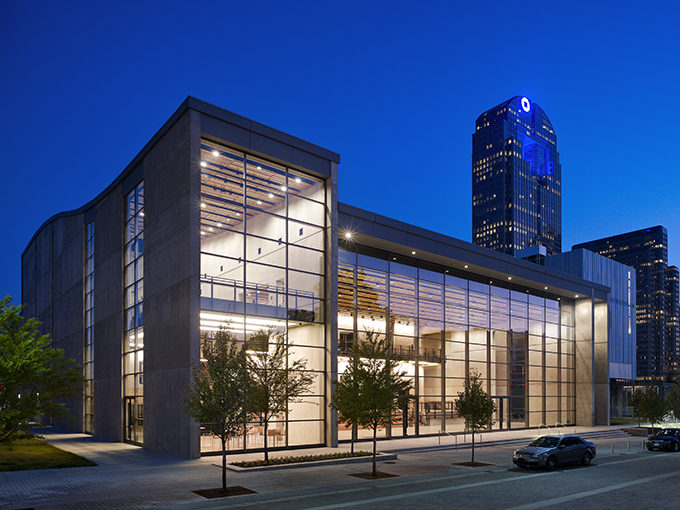
One of the most ambitious North American cultural and performing arts projects undertaken in recent decades, the 68-acre Dallas Arts District comprises several theaters, an opera house, a symphony center, comedy clubs, art museums, a sculpture center, a performing and visual arts high school, and other cultural venues.
The cast of design talent for the various, privately funded, mega-million dollar Arts District facilities is an architectural star map. It is SOM’s publicly funded Dallas City Performance Hall, however, that is frequently singled out as a true “village for the arts,” as it will serve as a home to a range of Dallas’ smaller theater, music, dance and performance companies.
This project has been largely free of the civic debate which so often accompanies arts funding and design. This is due, in large measure, to SOM’s singularly thorough research and development process: hundreds of local artists, performers, and audiences were interviewed by the firm’s designers to determine what was needed and desired in a new performance hall. The results of this intense research are manifested not only in the design—the massing of the linear pavilions, each lyrically articulated so that their purpose, navigation, and use is self-evident—but also in the graduated construction phasing of the entire complex.
The project entails two tightly budgeted construction phases. When both phases are complete, the center will feature a 750-seat acoustically flexible proscenium theater flanked by two multipurpose performance spaces seating 200 people each. The complex will include galleries, a café, gift store and bookshop, educational and meeting facilities, artistic support spaces, and an indoor garden.
Set on the southeast edge of Dallas’ Arts District, the hall was designed in concert with the Booker T. Washington High School for the Performing and Visual Arts across the street. Together, their engaging outward-facing architectural programs and related structural features will serve as a welcoming gateway to the Arts District. A richly detailed arcade passing through the heart of the Performance Hall complex enables commuters on their way to and from the nearby DART station to engage firsthand with the arts. Formally, the building is energized by the central arcade, with a dynamic series of ribbon-like roof forms imparting an alluring syncopated quality to the facility.